Chicken and Dumplings Recipe: A Creamy Stovetop Pot That Serves 6
Dumplings that melt into the broth are the most common way chicken and dumplings goes wrong, and the dough is rarely to blame. The broth is. Thin liquid can’t hold up a wet dumpling, so the underside soaks and sheds starch, and by minute six the whole pot has gone gluey.
Here the broth gets checked before any dough goes in. Drag a finger across the back of a coated spoon and look at the track. If the line stays open for a slow count of three, the pot is ready, and if it closes, the broth needs a few more minutes. I call it the finger line test. My first pot skipped it, and the dumplings sank like wet bread.
Everything else is forgiving. Bone-in thighs get seared hard, and the dumplings steam for ten minutes under a lid, then three more with it off so the tops dry. They finish risen and whole, though never crisp, because steam doesn’t brown dough.
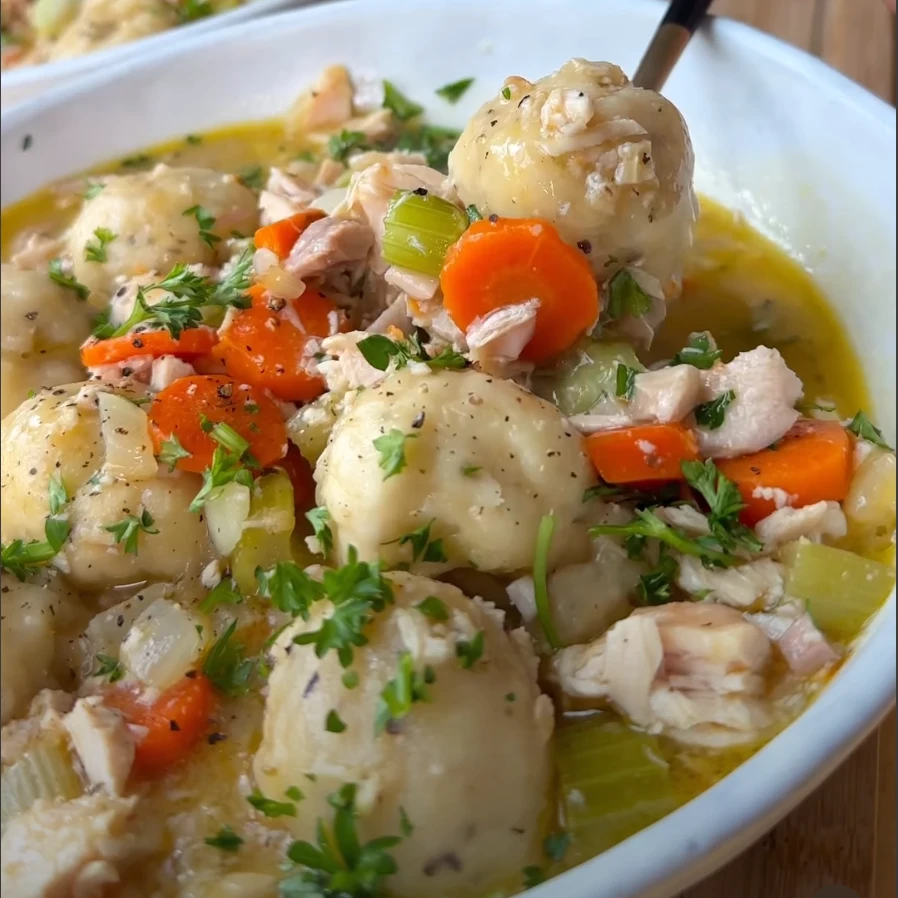
Why You’ll Love This Version
- Dumplings that keep their bottoms. A broth thickened to the finger line holds the dough up while it steams, so the underside sets into crumb instead of dissolving.
- One pot, one wash. Sear, soften, thicken and steam all happen in the same Dutch oven, and the browned bits end up in the broth, not the sink.
- The dough takes two minutes. Mix it while the thighs simmer.
- Freeze the stew, add dumplings later. The stew keeps three months in the freezer, and fresh dough turns a thawed batch into chicken and dumplings in about 30 minutes.
Recipe Snapshot
- Prep 20 minutes, cook 65 minutes, total 85 minutes
- Serves 6, about 2 dumplings per bowl
- Difficulty: Medium
- Decides the outcome: a broth that passes the finger line
Chicken and Dumplings Nutrition Information
| Nutrient | Amount Per Serving |
| Serving Size | 1 large bowl (430 g) |
| Servings Per Recipe | 6 |
| Calories | 520 |
| Protein | 27 g |
| Carbohydrates | 52 g |
| Fat | 21 g |
| Fiber | 4 g |
| Sugar | 8 g |
| Sodium | 980 mg |
Thigh meat supplies the protein in a bowl of chicken and dumplings, while butter, skin fat and flour supply the fat and carbohydrates. Salt and broth drive the sodium.
Values are estimates and vary by brand.
Ingredients for Homemade Chicken and Dumplings
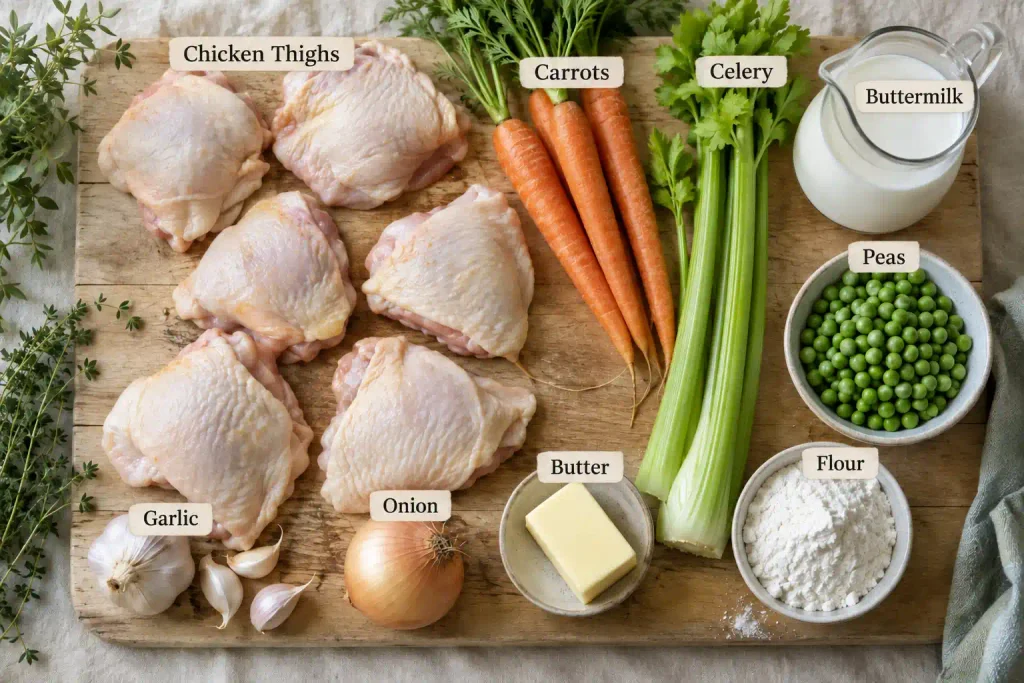
For the Stew
- 2 lb (900 g) bone-in, skin-on chicken thighs, because bones and skin give the broth body
- 1 tsp (3 g) Diamond Crystal kosher salt and 1/2 tsp (1 g) black pepper. Morton runs almost twice as salty per teaspoon, so use 2/3 tsp of it.
- 1 tbsp (15 ml) neutral oil, because butter scorches at searing heat
- 1 tbsp (14 g) unsalted butter
- 1 large yellow onion (250 g), diced
- 3 medium carrots (200 g), cut into 1/4 inch (6 mm) coins
- 3 celery ribs (150 g), sliced
- 4 garlic cloves (12 g), minced
- 1/3 cup (40 g) all-purpose flour, for the roux
- 6 cups (1.4 L) low sodium chicken broth, since the pot reduces and concentrates salt
- 2 bay leaves and 1 tsp (1 g) dried thyme
- 1/2 cup (120 ml) half-and-half for a silky finish
- 1 cup (140 g) frozen peas
- 2 tsp (10 ml) lemon juice, which keeps the cream from tasting flat
- 1/2 tsp (1.5 g) more kosher salt for the finish
For the Dumplings
- 2 cups (240 g) all-purpose flour
- 1 tbsp (12 g) baking powder, which does all the lifting
- 3/4 tsp (2 g) kosher salt
- 4 tbsp (57 g) unsalted butter, frozen 15 minutes so the flakes stay solid until steam reaches them
- 2 tbsp (8 g) chopped fresh parsley
- 1 cup (240 ml) cold buttermilk. If you’re out, sour 1 cup of whole milk with 1 tbsp lemon juice for 5 minutes; you lose a little tang.
Test the baking powder first. Stir 1/2 tsp into 1/4 cup of hot water; it should foam hard, and a weak fizz means flat dumplings.
Allergen and Dietary Disclosure
As written, this chicken and dumplings recipe contains milk (butter and half-and-half in the stew, buttermilk and butter in the dumplings) and wheat, which brings gluten (the flour in the roux and the dough). Eggs, tree nuts, peanuts, soy, sesame, fish and shellfish are absent. With halal certified chicken it is halal, nut free and egg free. It isn’t vegetarian, gluten free or dairy free.
For dairy, swap vegetable shortening for the butter and oat milk plus 1 tbsp lemon juice for the buttermilk; the dumplings brown less and lose their butter flavor. For wheat, use a 1:1 gluten free flour blend for both flours and expect a finer, more crumbly crumb. Some broth cartons carry celery or soy.
Equipment Needed
- Wide 6 to 7 quart Dutch oven. Width beats depth: dumplings swell to twice their size and fuse in a narrow pot.
- Tight fitting lid. Steam does the cooking, so a rattling lid ruins chicken and dumplings. Tuck foil under a loose one.
- Instant read thermometer. Thighs are safe at 165°F (74°C), but their connective tissue only softens near 175°F (80°C), which is why a thermometer earns its place.
- Box grater. It shreds frozen butter into flakes.
Prep Work Before the Burner Goes On
Pat the thighs dry, then salt and pepper them while you chop. Twenty minutes on the counter lets the salt work in, and dry skin browns where damp skin steams.
Chop the vegetables and mince the garlic. Whisk the dumpling flour, baking powder, salt and parsley together, grate the frozen butter in, and chill the bowl beside the buttermilk.
The pot needs three minutes empty over medium-high, until a drop of water skitters and vanishes. That heat is what browns the skin in stovetop chicken and dumplings.
How to Make Chicken and Dumplings Step by Step
Step 1. Sear the thighs
Get the oil shimmering over medium-high heat, about 375°F (190°C), then lay the thighs in skin side down. Leave them alone. Six minutes in, the skin turns dark amber and lets go of the pot, and two minutes on the other side finishes the sear before the thighs move to a plate.
Step 2. Soften the vegetables
Pour off all but 2 tablespoons of fat, keeping the brown crust called fond, which seasons the broth. The butter and vegetables go in for eight minutes at medium, around 300°F (150°C), until the onion turns translucent and the fond lifts. Garlic goes in for the last 30 seconds.
Step 3. Toast the flour
The 1/3 cup of flour goes over the vegetables, and two minutes of nonstop stirring makes a roux, flour cooked in fat so it thickens without a raw taste. It’s ready when the pot looks like damp sand and smells like pie crust.
Chef’s Note: Stop at pale blond. A darker roux tastes nuttier but thickens less. My first version used 1/4 cup of flour, and the finger line closed almost at once.
Step 4. Simmer the thighs
Warm broth goes in a cup at a time, stirred until the roux loosens, and then the herbs and thighs slide back in. Keep the lid tilted and the pot at a bare simmer near 195°F (90°C) for 20 minutes, with a few lazy bubbles and never a roll. Done means 175°F (80°C) and meat that gives under a press.
Step 5. Mix the cold dough
While the thighs simmer, pour the buttermilk into the chilled flour bowl and fold about 12 times. Stop while streaks of flour still show. More mixing builds gluten, the protein network that turns dough chewy, so cover the shaggy dough and chill it again.
Step 6. Shred the chicken
Rest the thighs on a board for five minutes while the pot keeps simmering. Pull the meat into chunks, leaving the skin and bones behind, and stir it back in with the peas and half-and-half. Fish out the bay leaves.
Step 7. Find the finger line
After four to six minutes at about 200°F (93°C), drag a finger across the back of a coated spoon. A track that closes in under three seconds means the broth is too thin for dough, and one that stays open means go. Stir in the lemon juice and remaining salt, tasting for slightly too salty, since dumplings absorb some.
Chef’s Note: If the track still closes after eight minutes, stir 1 tsp cornstarch into 1 tbsp cold water and pour it in.
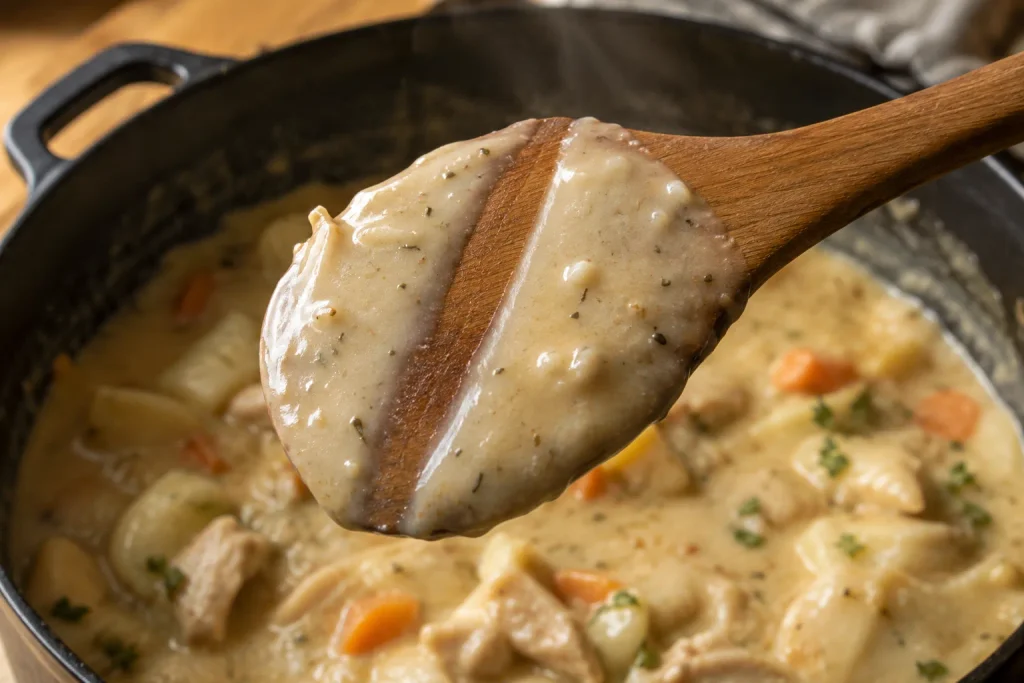
Step 8. Drop the dumplings
With the pot at a gentle bubble, scoop 12 mounds of dough, 3 tablespoons each, an inch (2.5 cm) apart so they can swell without fusing. Leave the tops ragged, and they puff higher. The lid goes on within a minute.
To double it, use a second pot. Dumplings need surface area, and 24 in one pot stack up and stay raw.
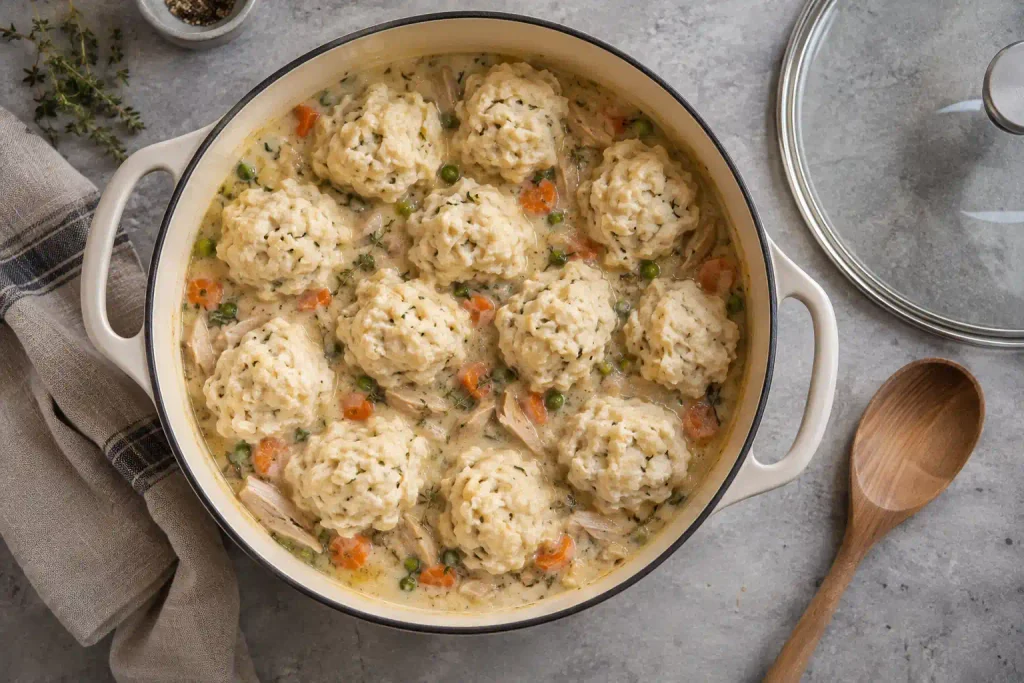
Step 9. Steam, then uncover
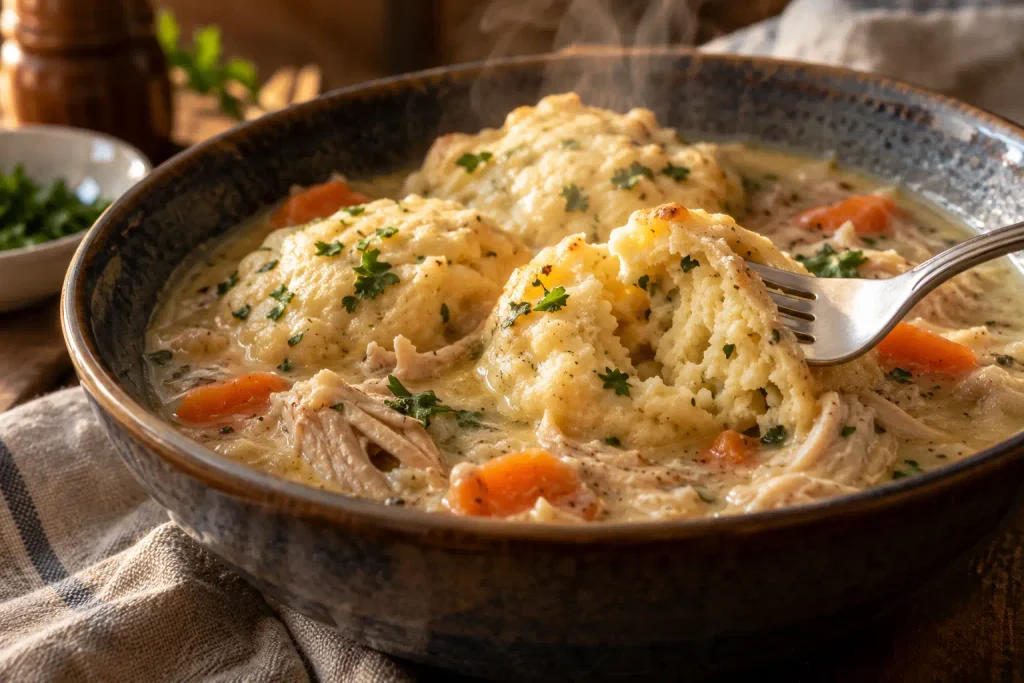
Ten minutes covered at a bare simmer, about 205°F (96°C), and no peeking, since each lifted lid lets out the cooking steam. Then the lid comes off for three minutes, until the tops turn from glossy and damp to matte and dry. A dumpling cut open should look cakey and read 195°F (90°C) at the center.
Chef’s Note: Minute eight fools you. A dumpling looks done then, but the center only sets in the last two minutes, so the lid stays down.
Tips for Fluffier Dumplings and a Better Broth
The stove mistake: dumplings into a hard boil. A rolling boil is the fastest way to wreck chicken and dumplings: it tosses the dough and tears the bottoms open before the crust sets. Drop the heat until the bubbles turn lazy, then wait for the finger line before you start scooping.
Make ahead. Freeze grated butter flakes in a zip bag.
Technique. Dip the scoop in hot broth between dumplings. The dough slides off in one piece.
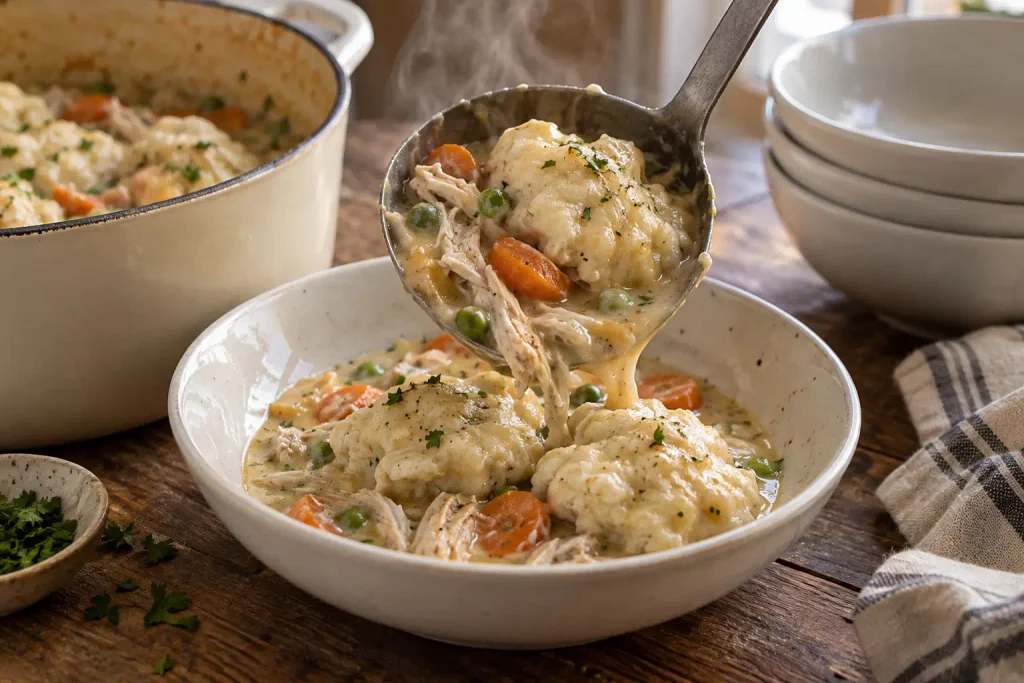
Texture. Rest the pot for five minutes. Off the heat, the broth tightens and the dumpling surfaces firm up, which is what lets them survive the ladle.
Time saver. Warm the broth in a kettle while the vegetables soften. Cold liquid clumps a hot roux.
Storage. Cool leftovers in containers no more than 2 inches (5 cm) deep, so the center chills within about two hours.
Common Mistakes and Troubleshooting
| Problem | Cause | Solution |
| Dumplings slump and dissolve | The broth was too thin, so the underside soaked and shed starch before a crust set | Wait for the finger line next time. To rescue a pot in progress, lift the dumplings out, stir in 1 tsp cornstarch mixed with 1 tbsp cold water, simmer 2 minutes, and slide them back |
| Dense, chewy dumplings | Too much mixing built gluten | Stop folding while streaks show, because a dense batch stays dense |
| Dry tops, gummy center | The lid came off early or the scoops ran large, so steam missed the middle | Cover again for 4 minutes at a bare simmer, and keep the lid down for the full 10 next time |
| Broth as thick as pudding | It reduced past the finger line, or the starch tightened as the pot cooled | Whisk in warm broth 1/4 cup at a time until the track holds for about three seconds, and thin it before the dumplings go in |
A pot of chicken and dumplings that is dissolving announces itself around minute four. The surface looks hazy, and each dumpling has a slumped, translucent edge where it meets the liquid. Nudge one and the bottom clings to your spoon like wet paste. That’s the moment to move: plate the dumplings, tighten the broth to the finger line, then slide them back under the lid for six more minutes. The tops survive. The bottoms stay a little soft, which is the honest cost of a rescue.
Storing Leftover Chicken and Dumplings
This pot shouldn’t sit out longer than 2 hours.
Refrigerator
Refrigerate leftover chicken and dumplings in lidded glass containers for up to 4 days. By day two the dumplings have swollen and drunk a third of the broth, so leftovers need extra liquid when you reheat them.
Freezer
Freeze the stew without dumplings in flat bags, 1 inch (2.5 cm) thick, for up to 3 months. Frozen dumplings come back spongy.
Reheating
Warm portions over medium-low with 1/4 cup of broth per two servings, stirring gently, until the center reaches 165°F (74°C). Microwave it covered, in 90 second bursts.
Chicken and Dumplings Variations and Swaps
Spicy. Add 1/2 tsp cayenne and 1 tsp smoked paprika with the flour. The heat builds overnight, so leftovers run hotter.
Mild. Skip the pepper and dice the vegetables to 1/8 inch (3 mm). You lose some layered bite.
Vegetarian. Use vegetable broth, 12 oz (340 g) of seared cremini and one 15 oz (425 g) can of white beans for body. Without bones, the finger line takes three or four minutes longer.
Gluten free. A gluten free roux thickens slowly, so the finger line can take three extra minutes, and the dough needs a 10 minute rest to hydrate.
Boneless thighs. Cut the simmer to 15 minutes and add a tablespoon of butter to the roux, since the broth comes out thinner without bones.
Whole milk for half-and-half. The stew turns less silky, and the finger line can take two minutes longer.
What to Serve With Chicken and Dumplings
The pot is soft and heavy. Sides should push the other way, starting with a green salad in lemon vinaigrette lemon vinaigrette green salad for acid and crunch.
Roasted green beans garlic roasted green beans bring char and a slight bitterness that a pale dinner lacks. Sweet iced tea homemade sweet iced tea clears fat from your tongue between spoonfuls, and its chill suits the heat of the pot. A grind of black pepper cuts the cream.
Frequently Asked Questions
Can I make chicken and dumplings the night before?
The stew can be made a day ahead, but the dough cannot. Chill it fast, and thin it with broth before you rerun the finger line test, because it sets like gravy overnight. Wet dough goes flat. Baking powder starts working the moment it meets buttermilk, so only the dry mix waits, chilled with the grated butter for up to two days.
Why does my chicken and dumplings broth taste like raw flour?
A roux stirred for under two minutes leaves a floury taste, because starch needs heat and time to lose its raw edge. Hold the pot at a bare simmer for six to eight more minutes. Then add the lemon juice. The broth will tighten past the finger line as it reduces, so loosen it with hot broth before the dough goes in.
Can I use self-rising flour for the dumplings?
Use 2 cups (240 g) of self-rising flour and skip the baking powder and most of the salt (1/4 tsp stays), since the flour already carries both. The crumb comes out a touch softer, because self-rising flour is usually milled from lower protein wheat. Check the date first. Old self-rising flour loses its lift, and your chicken and dumplings will come out flat.
How long can a pot of chicken and dumplings sit before serving?
With the burner off and the lid on, the pot holds for about 20 minutes before the dumplings start soaking up broth. On the lowest flame it stretches to 30, as long as the broth stays above 140°F (60°C). Past that the bottoms soften. The stew also thickens beyond the finger line, so stir in hot broth right before you ladle.
Can I use rotisserie chicken to skip the searing?
Rotisserie meat saves about 20 minutes in chicken and dumplings, but it costs the body that bones and skin give the broth. Use about 3 cups (400 g) of shredded meat with an extra tablespoon of butter in the roux, and simmer the vegetables in the broth for 12 minutes. A lighter broth needs longer to pass the finger line, so test it before the dough goes on.
What Decides the Pot
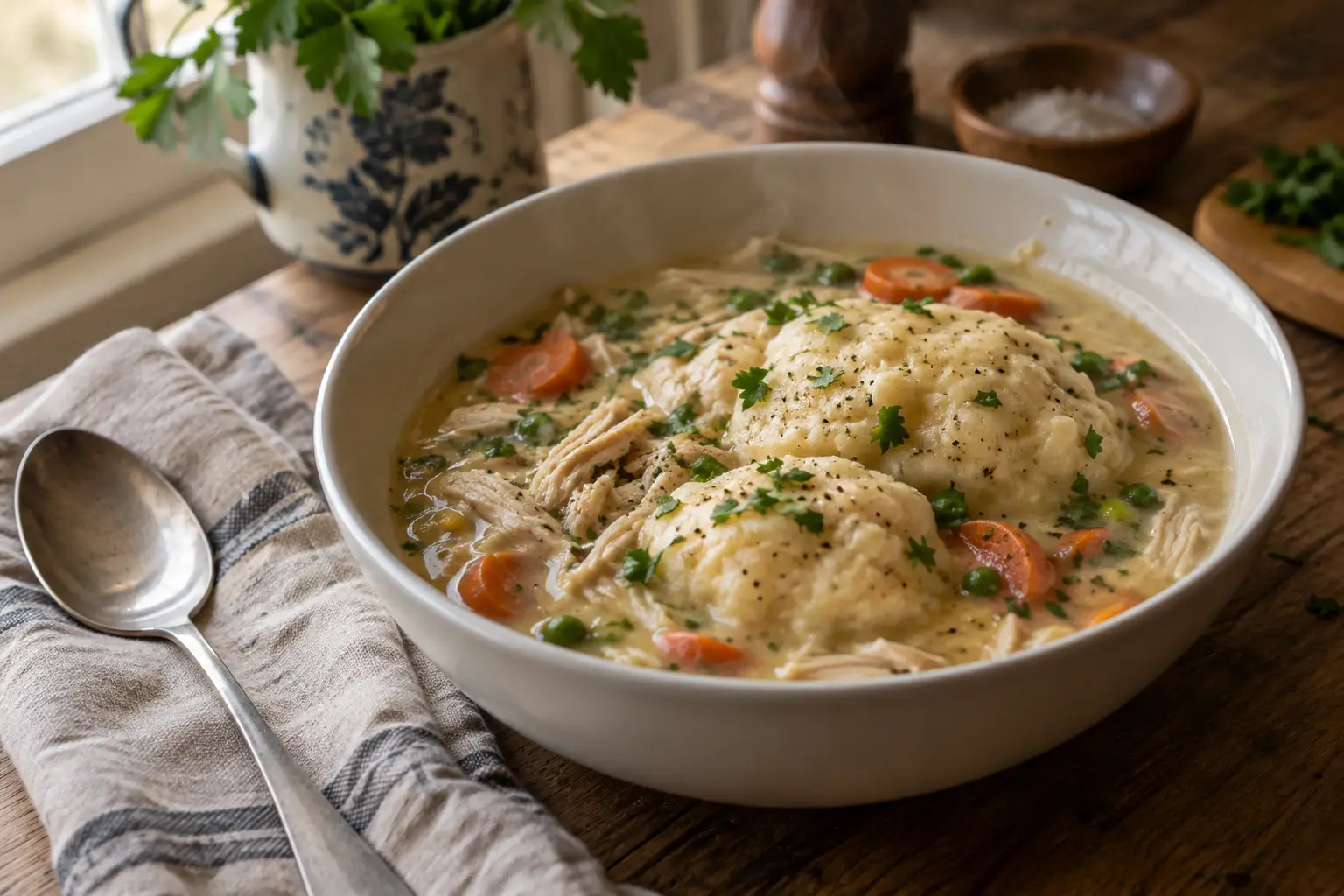
A spoon beats a timer. Every pot of dumplings that has failed on me failed the same way: the broth was thin before the dough went in, and nothing after that moment could fix it. Give the stew its extra five minutes, and wait until the finger line holds open for a slow count of three.
The rest is forgiving. Chicken and dumplings tolerates a swap of vegetables or a boneless thigh in place of bone-in, but it does not tolerate a hurried broth. Save this pin to your dinner board on Pinterest so the finger line is easy to find on the next cold night.

Creamy Chicken and Dumplings
Ingredients
Method
- Salt and pepper the thighs and let them sit 20 minutes.
- Heat the oil over medium-high, sear the thighs skin side down 6 minutes, flip 2 minutes, then plate.
- Pour off all but 2 tbsp fat. Cook the vegetables and butter over medium 8 minutes, adding the garlic at the end.
- Stir in the 1/3 cup flour for 2 minutes until it looks like damp sand.
- Add warm broth gradually, then the bay leaves, thyme and thighs. Simmer 20 minutes at 195°F (90°C) to reach 175°F (80°C) in the meat.
- Toss the dumpling flour mix with the grated butter, add buttermilk and fold about 12 times. Chill.
- Shred the chicken and return it to the pot with the peas and half-and-half.
- Simmer 4 to 6 minutes until a finger track across a coated spoon stays open for 3 seconds. Add lemon juice and salt.
- Scoop 12 dumplings, 3 tbsp each, onto the surface. Cover and steam 10 minutes.
- Uncover for 3 minutes until the tops look matte. Center should read 195°F (90°C).
![of field, food photography, natural textures, high detail, no text, no watermark] [ALT TEXT: Bowl of French onion soup with melted Gruyere crust and toasted baguette](https://www.flavoreal.com/wp-content/uploads/2026/09/french-onion-soup-hero-shot-768x512.webp "French Onion Soup Recipe: A Golden, Deeply Caramelized French Classic in 6 Steps 15")
One Comment
Comments are closed.