Pizza Dough Recipe with a Crispy Base and 6 Ingredients
A pizza crust is decided long before the oven, usually around minute 40. Too many homemade doughs double on the counter and get punched flat, leaving nothing for the oven.
This pizza dough recipe stops the rise early. At about 40 minutes the dough has grown by half, and that is when you cut it into balls. That is the half rise handoff. From there the same batch bakes tonight after 40 more minutes on the counter, or goes into the fridge for up to 72 hours.
Six ingredients do the work. At 70 percent water the dough sticks to everything and slumps when you move it. At 65 percent it holds its shape and still bakes with open, blistered edges on a hot steel.
Expect a crisp base and a chewy rim. A same day dough tastes milder than one that spent two nights in the fridge, so know that going in.
Why You’ll Love This Pizza Dough Recipe
- Bakes tonight, or waits three days. Dividing at half rise leaves headroom, so a fridge batch never slumps by day three.
- Crisp base, chewy rim. At 65 percent water this pizza dough recipe blisters at the edge and browns on a hot steel in about nine minutes.
- Most of the clock is waiting. Of the 2 hours 15 minutes, 90 are resting and rising that ask nothing of you.
- One batch feeds four. Two 12 inch pizzas give four people two slices each, and either ball can go in the freezer instead of the oven.
Pizza Dough Recipe at a Glance
- Prep time: 30 minutes, plus 80 minutes of rising
- Cook time: 25 minutes
- Total time: 2 hours 15 minutes
- Servings: 8 slices
- Difficulty: Easy
- Calories: 260 per serving, dough only
- Decides the outcome: a steel heated for 45 minutes
- Best for: pizza night, or a dough planned ahead
Pizza Dough Recipe Nutrition Information
| Nutrient | Amount Per Serving |
| Serving Size | 1/8 of the dough (109 g) |
| Servings Per Recipe | 8 |
| Calories | 260 |
| Protein | 8 g |
| Carbohydrates | 46 g |
| Fat | 4 g |
| Fiber | 2 g |
| Sugar | 1 g |
| Sodium | 490 mg |
Most of the protein comes from the gluten forming proteins in the flour, and the fat is olive oil. Sodium runs high for a plain dough because 10 g of salt is split among only eight servings.
Values are estimates and vary by brand.
Homemade Pizza Dough Ingredients
This pizza dough recipe uses six ingredients for the dough, and the toppings are only for a first test bake.
For the Dough
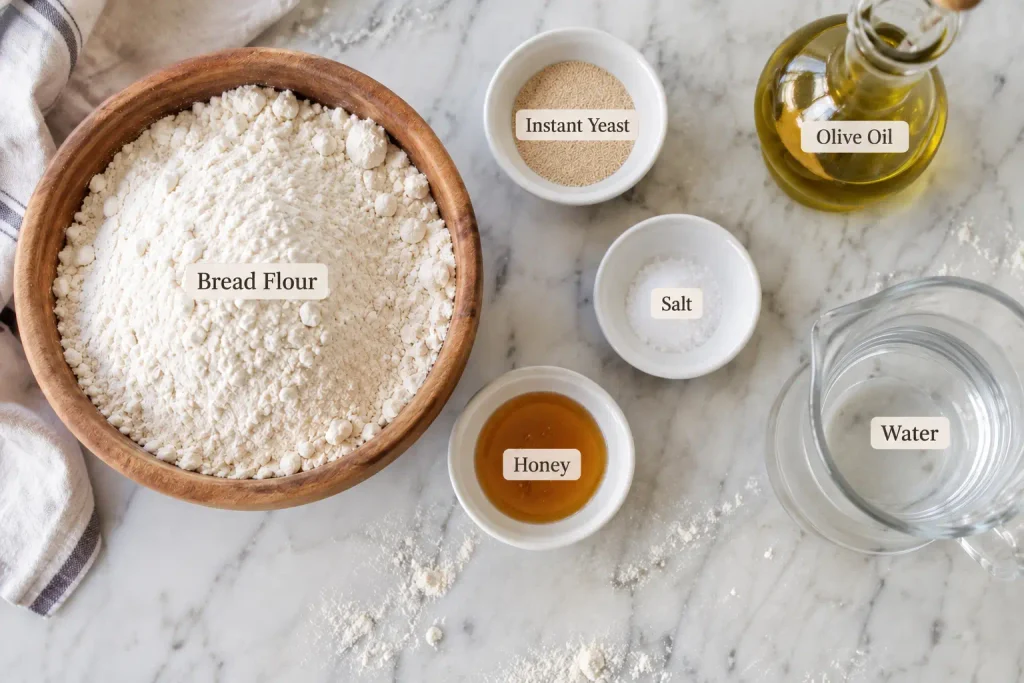
- 4 cups (500 g) bread flour, spooned and leveled. Extra protein builds the chew, and King Arthur or any bread flour works. All purpose flour needs only 1 1/4 cups (300 ml) water and bakes softer.
- 1 1/3 cups plus 1 tablespoon (325 ml) water at 100°F (38°C). That is 65 percent hydration, meaning the water weighs 65 percent as much as the flour.
- 1 teaspoon (3 g) instant yeast. It makes the gas that inflates the rim.
- 1 3/4 teaspoons (10 g) fine sea salt. It tightens gluten and slows the yeast so flavor can build.
- 2 tablespoons (30 ml) olive oil. Fat keeps the base from drying out before it browns.
- 1 teaspoon (5 g) honey or sugar. It feeds the yeast fast and helps the rim color.
A scooped cup of flour can weigh 30 g more than a spooned one. Extra flour makes dough bake dense.
For Topping Two Pizzas
- 1 cup (240 g) pizza sauce. Cook it down thick enough to spread flat.
- 8 ounces (225 g) low-moisture mozzarella, shredded. It browns without the water fresh mozzarella releases.
- 2 tablespoons fine semolina or cornmeal. The grains act like ball bearings under dough sliding off the peel, the flat loading paddle.
Allergen and Dietary Disclosure
As written, this pizza dough recipe contains wheat and gluten from the bread flour. The mozzarella carries milk, and any semolina on the peel is durum wheat.
Dietary status: halal, egg free, nut free, and not gluten free, with a dough that is also vegetarian and dairy free.
Wheat has no swap that works here. For milk, skip the mozzarella and brush the rim with garlic olive oil, though the pizza browns less and bakes flatter. Cornmeal is the hidden culprit, since mills that grind it often grind wheat too.
Equipment Needed
This pizza dough recipe needs four tools you may not own yet.
- Digital kitchen scale. Grams hold the water at 65 percent and give you two matching balls.
- Pizza steel or stone. It decides the bottom crust, so give it 45 minutes at 500°F (260°C) on the upper middle rack; a surface heated for 20 minutes lets the oven read hot while the base bakes pale. A flipped, heated rimless baking sheet is the fallback.
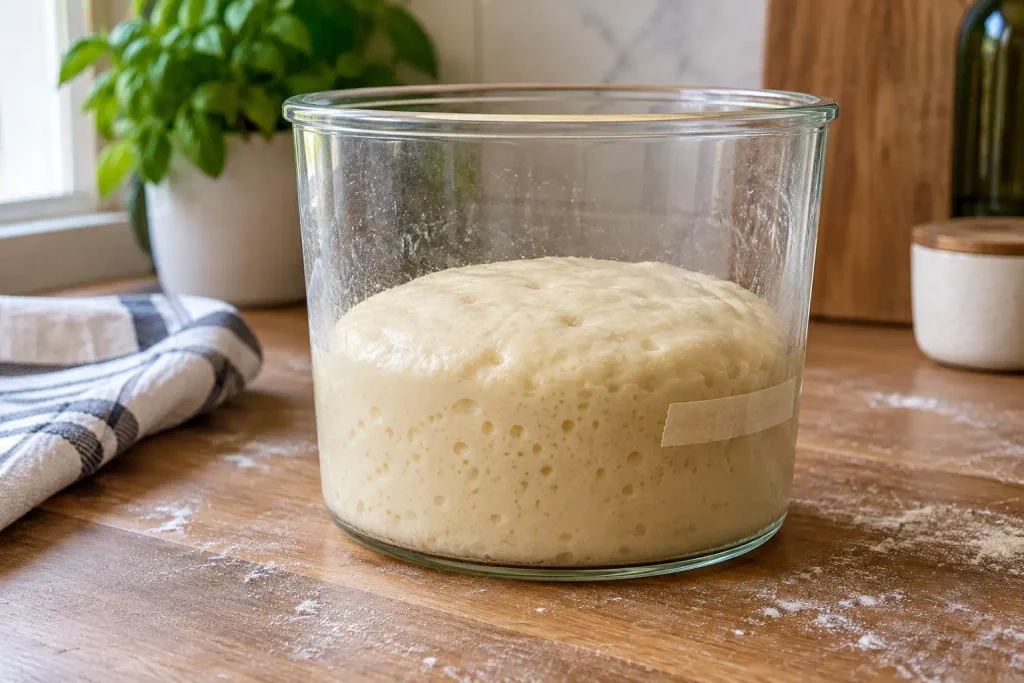
- Straight-sided 3 quart container. Tall walls plus a strip of tape at the starting height make the half rise easy to read from across the kitchen.
- Instant read thermometer. It confirms 100°F (38°C) water and dough near 78°F (26°C).
Preparation
Set everything out for this pizza dough recipe before the water touches the flour. Weigh the flour and salt into the mixer bowl, then check that the water reads 100°F (38°C).
Oil the container. Flour a rimmed sheet for the balls, and set the steel on the upper middle rack with the oven still off. Measure the sauce into two 1/2 cup bowls and shred the cheese now, since the first pizza cools while you hunt for a spoon.
How to Make This Pizza Dough Recipe Step by Step
Step 1. Mix the dough
Stir the yeast and honey into the 100°F (38°C) water; pinprick bubbles gather at the rim within two minutes. Add the oil, then the flour with the salt on top. Mix on low for 2 minutes until the mass looks ragged with no dry streaks.
Step 2. Rest the shaggy dough
Ten minutes under a damp towel saves kneading. A fingertip pressed in leaves a soft, slow-filling dent.
Step 3. Knead until smooth
Eight minutes at speed 2 in a stand mixer, or about 12 by hand, turns the mass smooth and slightly tacky. A golf ball sized piece should stretch thin enough to show light before tearing, the windowpane test for gluten that can hold gas. Aim for 78°F (26°C).
Step 4. Start the half rise
Round the dough and drop it into the oiled container, then tape the starting height on the outside. At 72 to 75°F (22 to 24°C) it climbs halfway to double in about 40 minutes, with a domed top and a wobble when you tap the side. That is the handoff: tonight’s oven or the fridge comes next.
Chef’s Note: Dough at 72°F (22°C) after kneading needs 15 extra minutes to reach the line, and at 82°F (28°C) 10 fewer, so trust the tape.
Step 5. Divide into tight balls
Cut two 435 g pieces on the scale. Cup each under your hand and drag it in small circles on an unfloured counter until the skin tightens and squeaks, then pinch the seam underneath.
Chef’s Note: In this pizza dough recipe, cutting at half rise barely deflates the dough. A fully doubled dough loses gas its gluten spent hours holding, so it turns limp in the fridge.
If the dough has doubled already, skip the fridge for this batch. Divide it gently and bake within 30 minutes.
Step 6. Rest or refrigerate
Balls for tonight proof, meaning they take their final rise, under a cloth on a floured tray for 40 minutes while the oven heats to 500°F (260°C) with the steel inside. A floured fingertip pressed in should leave a dent that fills back slowly. Later balls go into oiled, lidded fridge containers.
Chef’s Note: A dent that snaps back wants 10 more minutes. One that stays and sinks means the ball has overshot, so bake it now on a thinner base.
Step 7. Stretch by hand
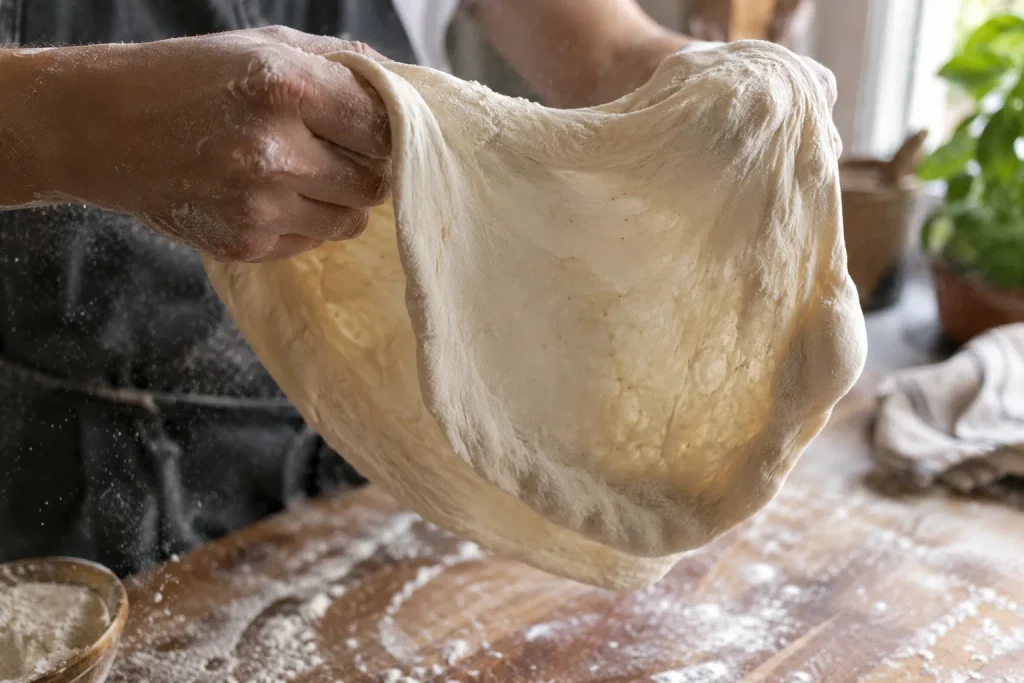
Press a ball flat with your fingertips on a lightly floured counter and leave a 1 inch rim untouched to trap the gas. Keep the rolling pin in the drawer. Drape the disc over your knuckles and let gravity pull it to 12 inches as you turn it. The center should look nearly translucent.
Step 8. Top and slide
Set the round on a semolina-dusted peel and spread 1/2 cup of sauce to within 1 inch of the rim. Scatter on 4 ounces of cheese. One shake should make it glide; if an edge grabs, dust more semolina beneath. It lands on the steel with a sizzle.
Step 9. Bake until blistered
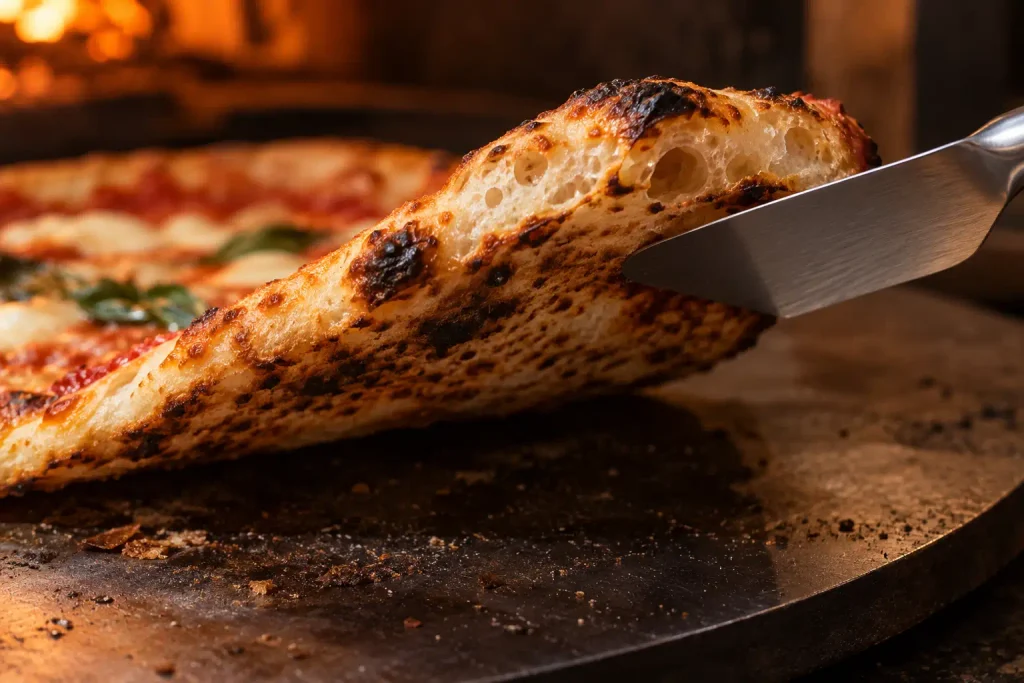
Eight to 10 minutes at 500°F (260°C) turns the rim deep amber with dark blisters and leaves the cheese bubbling, freckled with brown. Two minutes on a rack before slicing lets the steam under the base escape. The second ball gets the same treatment.
Expert Tips for This Pizza Dough Recipe
Keep your hands out of the flour bag. At minute 3 the dough smears across the bowl and more flour looks tempting. Wait. By minute 6 it lets go of the walls, because pizza dough at this weight is meant to feel tacky.
Shred the cheese ahead. Mozzarella shredded a day early and left loosely covered dries a little, so it browns in patches instead of pooling.
Give the fridge container room. Cold dough from this pizza dough recipe keeps growing slowly, so pick a container three times the ball’s volume and label the lid.
Dust lightly and brush off the top. Loose flour scorches at 500°F (260°C) and tastes bitter.
Oil the rim. A teaspoon of olive oil brushed on the exposed edge browns it deeper and crisps the shell.
Weigh straight into the bowl. Put the mixer bowl on the scale and zero it, then add the flour and pour in the water; no cups to wash.
Pizza Dough Problems and How to Fix Them
| Problem | Cause | Solution |
| The dough pulls back as fast as you stretch it | Gluten that has not relaxed, from balls that rested briefly or came cold from the fridge | Cover the round with a bowl for 5 minutes, then stretch again |
| After two days in the fridge the dough is a sticky puddle | It doubled before it chilled, so the gluten was spent and the yeast kept working | Fold it into a tight ball with floured hands and bake a thin pizza that night. Next time refrigerate at the tape line, the half rise handoff |
| The crust bakes up pale and dry | The steel was underheated, so the base dried out before it browned | Broil it on the top rack for 60 to 90 seconds. Next time heat the steel a full 45 minutes |
| The center is gummy under the sauce while the rim is done | Sauce and cheese pile steam onto a center too thick to dry | Give it 2 more minutes on the steel. Next time stretch the center to about 1/8 inch |
Pull-back catches everyone first with any pizza dough recipe. You press a ball to nine inches and look away to flour the peel, and the round has drawn back to seven, with a thick edge and a surface as tight as a drum. Stretching harder only tears holes. Five minutes under a bowl relaxes the gluten, and the same dough then reaches twelve inches in two gentle passes.
How to Store Pizza Dough and Baked Slices
Refrigerator
Balls from this pizza dough recipe, handed off at half rise, keep 72 hours at 38°F (3°C) in oiled, lidded containers. By day two, small bubbles line the container wall, and the base of the ball softens first. Baked slices last 3 days.
Freezer
Freeze balls at the handoff, oiled and bagged, for up to 3 months and thaw them overnight in the fridge. Baked slices keep 2 months.
Reheating
A covered skillet over medium heat crisps a slice in 3 minutes. A whole pizza needs about 8 minutes at 400°F (200°C).
Pizza Dough Recipe Variations and Substitutions
Spicy. Add 1 teaspoon crushed red pepper flakes to the flour and oil the rim, because bare flakes scorch at 500°F (260°C).
Mild and kid friendly. Cut each ball into four 108 g pieces and stretch them to 5 inches, then bake 5 to 6 minutes; small rounds brown fast.
Vegetarian. The dough already is. Roasted peppers and artichokes add sweetness and acid, plus salt, so leave it out of the sauce.
Gluten free. A gluten free blend cannot swap in one for one; it makes a spreadable batter baked at 450°F (230°C) on parchment, crisp but without the stretch.
Whole wheat. Swap 100 g of the flour and add 1 tablespoon (15 ml) water for a nuttier flavor and less rim spring.
Pan pizza. Press one ball into an oiled 10 inch skillet and bake 15 to 18 minutes at 475°F (245°C) for a fried, crisp base.
What to Serve with Pizza
The rest of the plate should answer what this pizza dough recipe leaves out: acid and something cold. An arugula salad does both, since peppery leaves and lemon cut through the cheese.
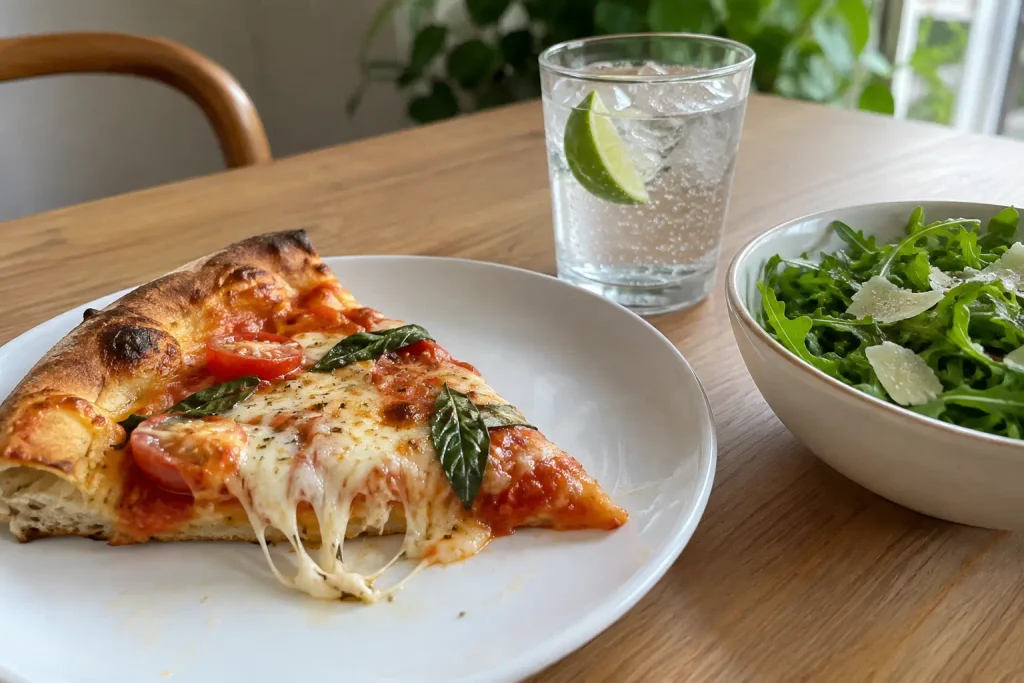
Garlic butter suits the rim, the one part with no sauce. Cold sparkling water with lime clears salt and oil off the palate, and a double batch turns one extra ball into garlic knots, whose buttery crumb suits the crisp base.
Pizza Dough FAQs
How long should chilled pizza dough warm up?
Sixty to 90 minutes on the counter. The ball should lose its chill and feel like room temperature clay, because cold dough tightens when stretched and bakes into a thick, torn round. Keep the lid on while it warms, then poke it and check that the dent fills back slowly. A make ahead pizza dough recipe behaves like a fresh one after that point.
Why didn’t my pizza dough rise?
Suspect the water first. Anything hotter than 130°F (54°C) weakens instant yeast before it can make gas, so check with a thermometer instead of the tap. A kitchen below 68°F (20°C) is the other common cause, and cold dough may need up to 30 extra minutes to reach the tape line on the container. Wait for the line before you judge it.
Can I use active dry yeast in this pizza dough recipe?
Active dry yeast works at 1 1/4 teaspoons, stirred into the warm water with the honey for 5 to 10 minutes. A foamy cap means it is active; a flat surface means the packet is stale and the dough will not rise. Expect the half rise to run about 10 minutes longer, since active dry wakes more slowly. Everything after that stays as written.
How do I know the crust is done?
Lift an edge with a spatula and tap the base: a hollow knock and a deep golden color flecked with dark spots mean it is done. An instant read thermometer through the rim should read about 205°F (96°C). A pale base with a dull thud needs another minute or two on the steel, so keep watching the top. Check every 30 seconds.
Why does my crust taste like bread?
Plain bread flavor comes from too little salt or too little time. The 10 g of salt here is 2 percent of the flour weight, so trimming it flattens the taste. Time is the bigger lever. A pizza dough recipe that rises for only an hour builds little flavor, while balls handed off at half rise and baked two days later taste tangier.
Watch the Line, Not the Clock
The tape on the container matters more than any item on the ingredient list. A kitchen at 68°F (20°C) and one at 78°F (26°C) will never agree on what 40 minutes means, but both agree on the half rise line, which decides whether the dough heads for tonight’s oven or a slow stay in the fridge.
A batch held two days cold beats a same day one, because the rim blisters darker and the base crisps harder.
Save this pizza dough recipe to your pizza night board on Pinterest so the timings and the tape trick are one tap away next time.


Homemade Pizza Dough
Ingredients
Method
- Stir the yeast and honey into the warm water until it clouds.
- Add the oil, then the flour and salt, and mix on low for 2 minutes.
- Cover and leave for 10 minutes.
- Knead 8 minutes by mixer or 12 by hand, until it passes the windowpane test.
- Tape the container at the dough’s height and let it rise 40 minutes to half again.
- Cut two 435 g pieces and tighten each into a ball.
- For tonight, cover the balls for 40 minutes and heat the oven to 500°F (260°C) with the steel inside. For later, refrigerate them in oiled containers.
- Stretch each ball to 12 inches with a 1 inch rim.
- Spread 1/2 cup sauce, add 4 ounces of cheese, and slide onto the steel.
- Bake 8 to 10 minutes until the rim is amber and blistered, then rest 2 minutes on a rack.