Chicken Parmesan Recipe with Crispy Cutlets in 60 Minutes
The crust bends like wet cardboard when the spatula slides under it. That is where most chicken parmesan goes wrong, and the frying isn’t to blame. The sauce sat on the crumbs for 10 minutes in the oven, and tomato water soaked in the whole time.
This chicken parmesan recipe changes where the sauce lands. Each cutlet gets 3 tablespoons in the middle and a bare ring of crust, about 3/4 inch (2 cm) wide. I call that ring the dry collar. The cheese stays inside it, and the cutlets finish on a wire rack so hot air reaches the underside.
Pound the chicken to an even 1/2 inch (1.25 cm) so the thin end doesn’t dry out first. Rest the breading for 10 minutes before it meets the oil, because a coating that hasn’t bonded slides off in one sheet. Everything else is ordinary cooking, and the whole dinner takes about an hour.
Why You’ll Love This Chicken Parmesan Recipe
- Crunch that lasts through dinner. Only the middle of each cutlet gets sauce, so the outer crumbs stay dry and still snap a quarter hour after the oven.
- The sauce cooks while you bread. Fifteen minutes on the stove is exactly the window the breading needs for its rest.
- Fry now, finish later. Fried cutlets keep a day in the fridge, and 12 minutes in the oven makes a hot dinner for a full table.
- One skillet, one pan. Drips fall through the rack instead of pooling under the crust.
Chicken Parmesan at a Glance
- Prep time: 30 minutes, including a 10 minute rest
- Cook time: 30 minutes
- Total time: 60 minutes
- Servings: 4 cutlets
- Difficulty: Medium
- Calories: about 600
- Decides the outcome: the wire rack
- Best for: weekend supper or company
Nutrition Information
| Nutrient | Amount Per Serving |
| Serving Size | 1 cutlet with sauce (about 280 g) |
| Servings Per Recipe | 4 |
| Calories | 600 |
| Protein | 55 g |
| Carbohydrates | 26 g |
| Fat | 32 g |
| Fiber | 2 g |
| Sugar | 4 g |
| Sodium | 980 mg |
About 33 g of the protein in one cutlet of this chicken parmesan recipe comes from the chicken and roughly 10 g from the mozzarella. Frying oil left in the crust and the cheeses supply most of the fat. Sodium comes mostly from the cheeses and canned tomatoes.
Values are estimates and vary with brands, measuring, and substitutions.
Chicken Parmesan Recipe Ingredients
For the cutlets
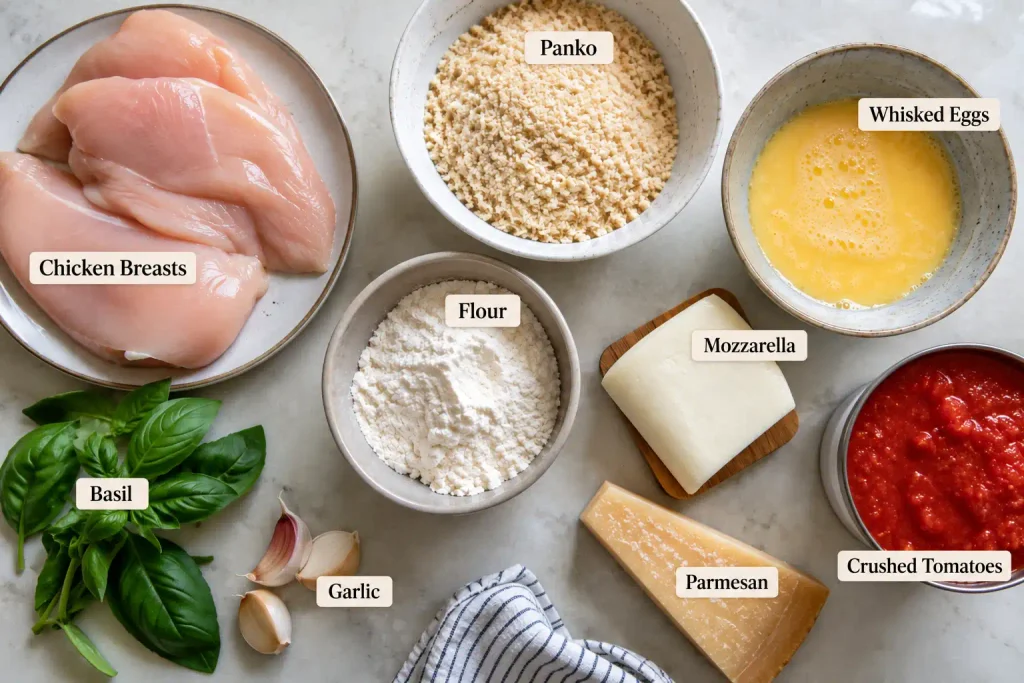
- 2 large boneless, skinless chicken breasts, about 10 oz (285 g) each, halved into four cutlets
- 1/2 tsp Diamond Crystal kosher salt (1.5 g) and 1/2 tsp black pepper (1 g). Morton is denser, so use 1/4 tsp.
For the breading
- 1/2 cup (65 g) all-purpose flour
- 2 large eggs beaten with 1 tbsp (15 ml) water
- 1 cup (60 g) panko breadcrumbs, whose jagged flakes hold less oil than fine crumbs. Crushed crackers, 3/4 cup (65 g), stand in.
- 1/4 cup (25 g) finely grated Parmesan, 1/2 tsp dried oregano and 1/2 tsp garlic powder, stirred into the panko
- 1 cup (240 ml) avocado or canola oil for shallow frying
For the sauce
- 1 tbsp (15 ml) olive oil and 3 garlic cloves, minced
- 1 can (14 oz / 400 g) crushed tomatoes, which thicken faster than whole ones. Passata, 1 3/4 cups (420 g), needs 5 more minutes.
- 1/2 tsp sugar (2 g) to soften the tinny edge, 1/4 tsp fine sea salt (1.5 g), and 6 basil leaves plus a few to finish
For the topping
- 6 oz (170 g) low-moisture mozzarella in 8 slices, 1/8 inch (3 mm) thick. Fresh mozzarella weeps whey, the watery liquid in curds, onto the crust.
- 1/4 cup (25 g) finely grated Parmesan
Allergens and Dietary Notes
As written, this chicken parmesan recipe has milk in the mozzarella and Parmesan, and eggs in the wash. Wheat, which brings gluten, comes from the flour and the panko, and the recipe has no peanuts, tree nuts, soy, sesame, fish, or shellfish.
Dietary status: nut free. It is not vegetarian, gluten free, dairy free, or egg free.
For dairy, a plant based mozzarella replaces both cheeses but melts slowly and browns in patches, so allow 3 extra minutes. For eggs, 6 tbsp (90 ml) of aquafaba, the liquid from canned chickpeas, works, though the crust comes out thinner and darker.
Check the panko bag. Some brands add milk solids or soy flour.
Equipment Needed
- 12 inch heavy skillet. Cast iron or thick stainless holds heat when cold cutlets land, so the crust browns instead of soaking.
- Meat mallet and plastic wrap. Bare chicken tears under a mallet.
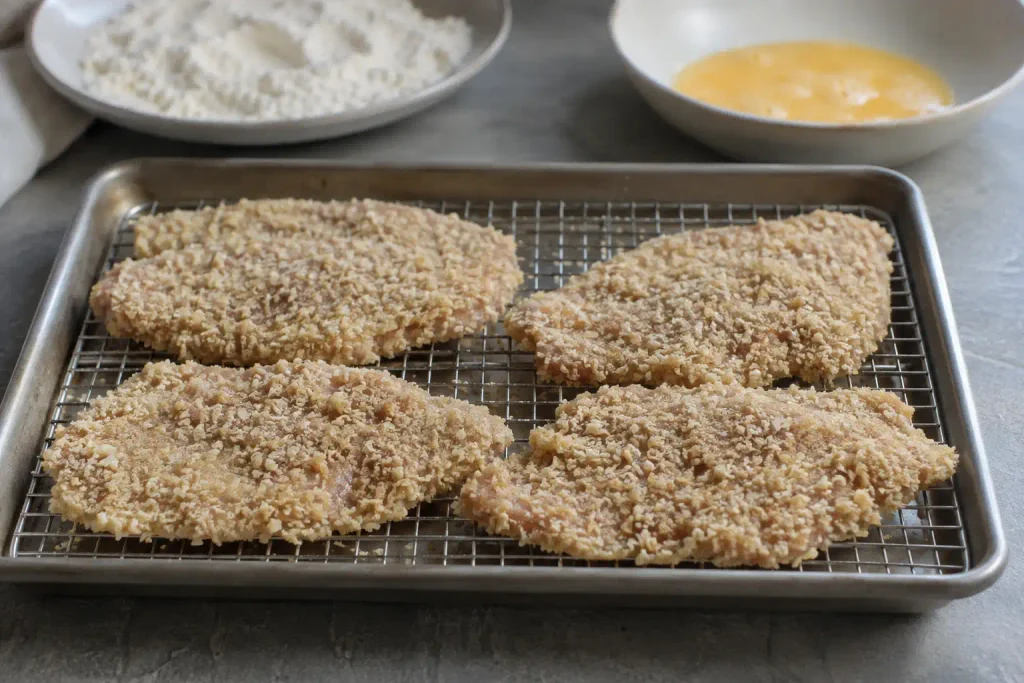
- Wire rack set in a rimmed sheet pan. It decides the bottom crust of any chicken parmesan recipe. Spray the wires with oil first, or the crumbs weld to the metal and tear away when you lift the cutlets.
- Instant read thermometer. Breast meat goes from juicy to chalky in a few degrees, and melted cheese hides the color that would warn you.
Prep Before the Oil Heats
Pull the chicken out 15 minutes early. A cold center browns outside long before the middle catches up, and every chicken parmesan recipe is a race between those two clocks.
Set three shallow dishes in a row: flour, eggs beaten with the water, then panko stirred together with the Parmesan and dried seasonings.
Set a rack in a foil lined pan. Switch the oven to 425°F (220°C) when the breaded cutlets start resting, so it is ready when the last one leaves the skillet.
How to Make Chicken Parmesan Step by Step
Step 1. Simmer the sauce
Warm the oil and garlic over medium-low for 1 minute, until the garlic smells sweet but hasn’t colored. Add the tomatoes with the sugar and salt and simmer near 195°F (90°C) for 15 minutes, until a spoon drags a trail that stays open. Stir in the basil.
Chef’s Note: Thick sauce is the whole plan in a chicken parmesan recipe, since a loose one soaks the crust.
Step 2. Butterfly and pound
Butterfly each breast, meaning split it into two thinner halves: press a hand flat on top and slice through the side, parallel to the board. Pound each half between plastic wrap to 1/2 inch (1.25 cm), until the thick end stops pushing back against your fingertip. Salt and pepper both sides.
Step 3. Bread and rest
Blot the cutlets dry and dredge each in flour, meaning a light dusting tapped free of excess, then dip in egg and press hard into the panko until crumbs stop falling off. Park them on the rack for 10 minutes. Tacky flour holds the crust on.
Step 4. Fry in two batches
Oil at 350°F (175°C), about 1/4 inch (6 mm) deep, is the target before any chicken goes in. Fry two cutlets at a time, roughly 2 1/2 minutes per side, until the crust is deep gold and the sizzle settles to a steady fizz. Inside they should read about 145°F (63°C); the oven finishes them.
Chef’s Note: Salt the crust the second it leaves the oil, and rest the cutlets on the rack, never paper towels, which trap steam against the bottom.
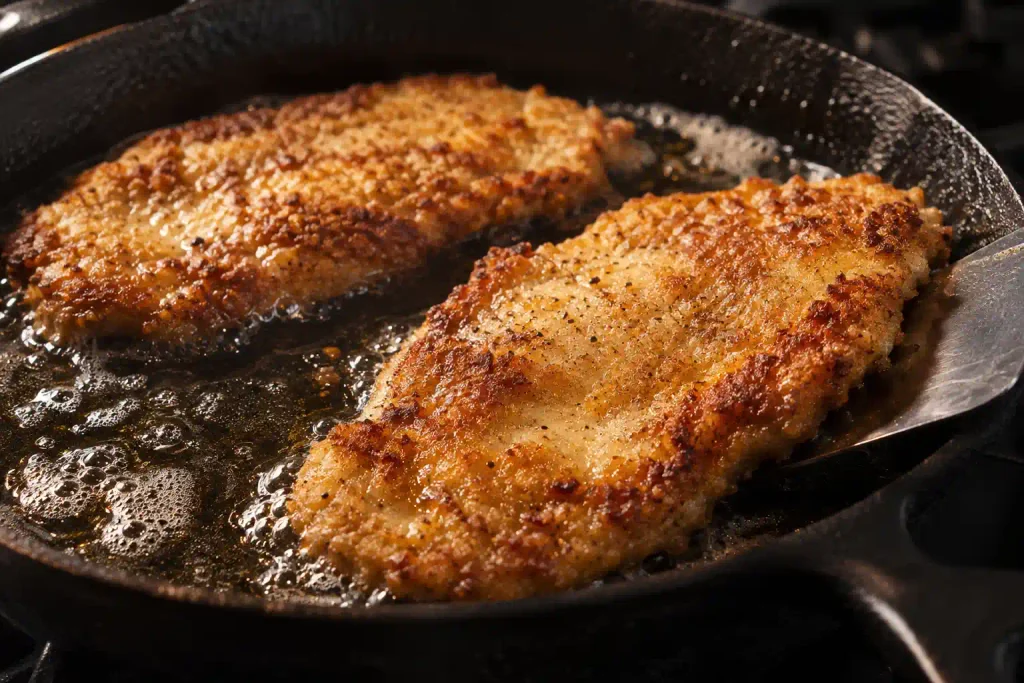
No thermometer? One pinch of panko in the oil should sizzle at once and turn light gold in about 30 seconds. Faster means the oil is too hot.
Step 5. Dress the centers
Back on the rack, spoon 3 tablespoons (45 ml) of sauce into the middle of each cutlet and cover it with mozzarella and Parmesan. Leave a 3/4 inch (2 cm) border bare. That ring is the dry collar, and the cheese creeps toward it without covering it.
Chef’s Note: My first ratio for this chicken parmesan recipe was a quarter cup of sauce, which crept past the collar and softened the edge by minute six.
Step 6. Bake on the rack
Eight to 10 minutes at 425°F (220°C) does it. Look for melted, blistered cheese with brown freckles and 165°F (74°C) in the thickest cutlet. Pale cheese at 8 minutes gets 60 seconds under the broiler, since freckled turns to burnt fast.
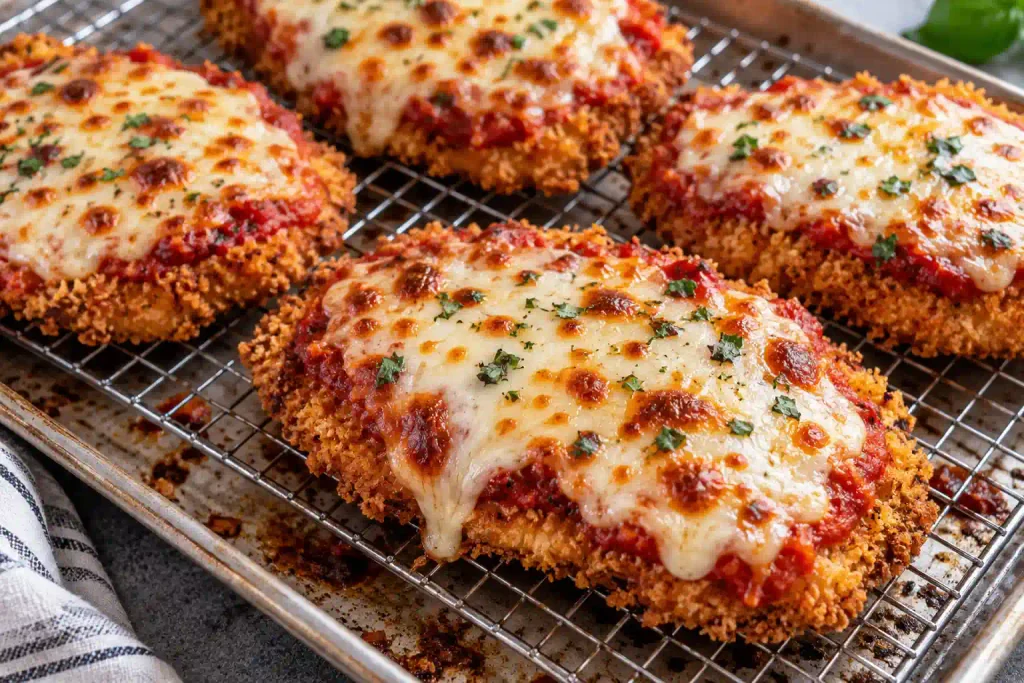
Use the middle rack. Higher up, the mozzarella scorches before the center reaches 165°F (74°C), and lower down the crumbs darken before the cheese browns.
Step 7. Rest, then plate
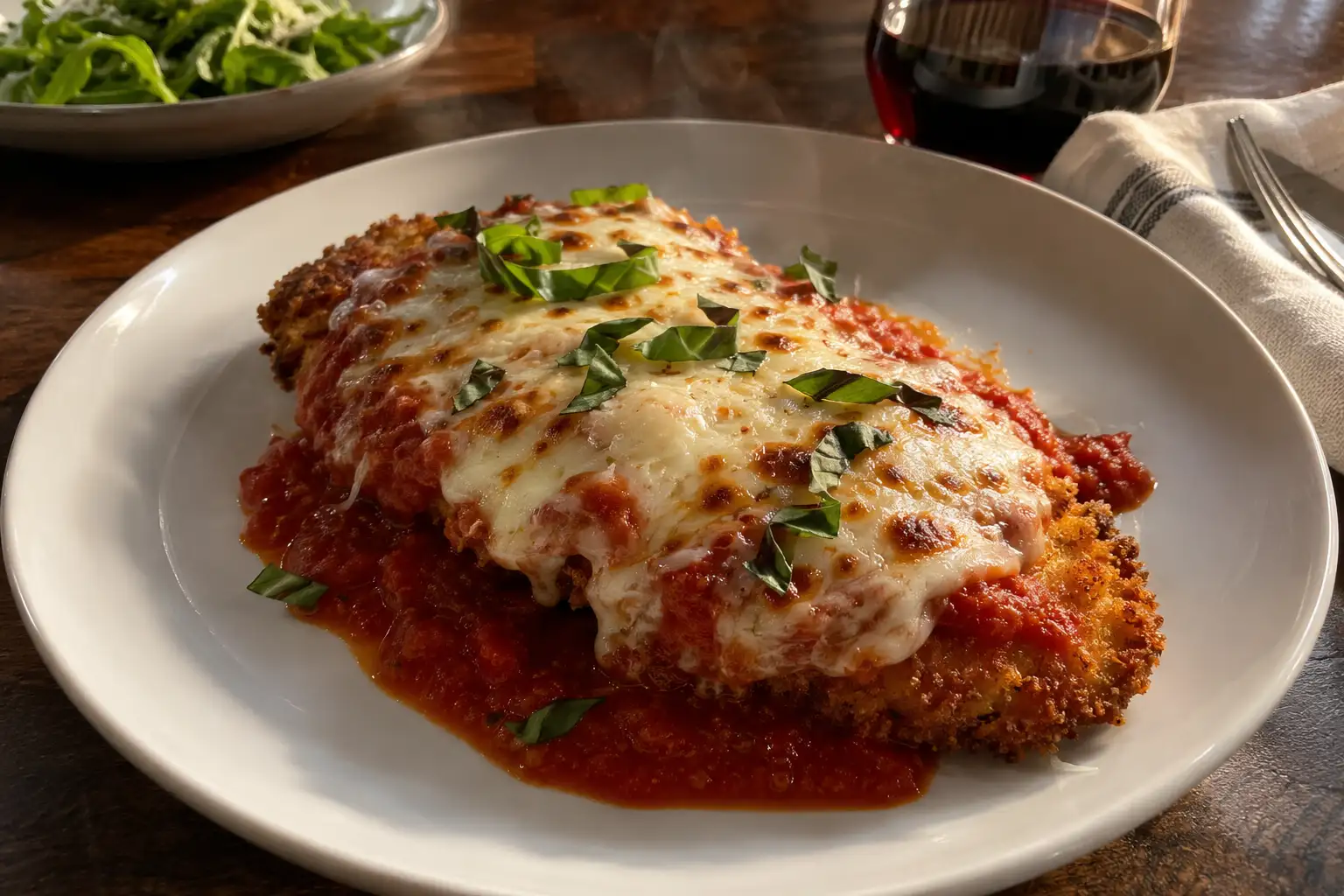
Three minutes on the rack lets the cheese firm up and the underside steam escape. Spoon the remaining sauce (about 3/4 cup or 180 ml) beside each cutlet, not under it, and finish with basil.
Tips for a Crust That Lasts
Crowding the skillet is the classic mistake. Four cutlets at once drag the oil from 350°F to about 300°F (150°C), and you hear it: the roar drops to a mumble while the crust soaks up oil.
Keep one hand dry. Flour and panko with one hand, egg with the other, or your fingers become breaded clubs.
Slice the mozzarella at 1/8 inch (3 mm). Thick slabs melt into a rubbery cap that lifts off whole.
Store bought cutlets skip the butterflying. Any chicken parmesan recipe assumes 1/2 inch, so pound packaged cutlets that run thicker, and thin ones change how long to bake chicken parmesan: 6 to 8 minutes.
Bread up to 4 hours ahead. Uncovered on the rack in the fridge, the surface dries into a shell that fries crunchier.
Keep leftover sauce in a jar. It thickens overnight and keeps 5 days; a spoonful of water loosens it.
Chicken Parmesan Recipe Problems and Fixes
| Problem | Cause | Solution |
| The crust slides off in one sheet | Damp meat or missing flour left the egg nothing to grip, or the rest was skipped | Blot dry, flour the meat, rest the breaded cutlets 10 minutes, and press any lifting patch flat mid fry |
| Soggy edges after baking | Sauce ran over the crumbs and steam pooled under the cutlet | Stop the sauce 3/4 inch (2 cm) from the edge to keep the dry collar, and bake on the rack with sauce thick enough to hold a trail |
| Pale, greasy crumbs | The oil sat near 300°F (150°C), so the crust drank it before browning | Hold 350°F (175°C) and fry two at a time. Greasy cutlets go on a rack in a 425°F (220°C) oven for 3 minutes |
| The thin end is dry | An uneven cutlet, so the tail finished while the thick end caught up | Pound to an even 1/2 inch (1.25 cm) and pull the pan at 165°F (74°C). Carryover heat, warmth still moving inward after the pan is out, adds a few degrees |
The soft edge is the most common failure in any chicken parmesan recipe, and from above it looks like success. The cheese blisters and the sauce bubbles. Then the spatula goes under and the bottom bends instead of snapping, because tomato water crept into the crumbs while steam pooled below. Wipe sauce off the outer ring and bake the cutlets back on the rack at 450°F (230°C) for 4 minutes.
How to Store Chicken Parmesan
Room temperature storage does not apply. Cooked chicken with cheese shouldn’t sit out past 2 hours.
Refrigerator
Cool the cutlets on the rack for 20 minutes, then stack them in a shallow lidded container with parchment between layers. They keep 3 days, and the bottom crust softens first while the collar holds out.
Freezer
Freeze finished cutlets flat on a tray for 1 hour, then bag them with the air pressed out. They hold 2 months.
Reheating
Thaw frozen cutlets overnight in the fridge, then heat them on a rack at 375°F (190°C) for 12 to 15 minutes, until the center reads 165°F (74°C).
Make Ahead
This chicken parmesan recipe can be made ahead in two stages: fry the cutlets up to 24 hours early and refrigerate them uncovered on the rack. Add sauce and cheese when dinner is close and bake at 425°F (220°C) for 12 minutes, since they start cold.
Variations and Substitutions
Spicy. Stir 1 tsp Calabrian chili paste into the garlic oil, though it mutes the tomato’s sweetness, so try 1/2 tsp first.
Mild. Fry 1 inch (2.5 cm) strips 90 seconds per side and dip them in plain sauce. Small hands like them. The cheese cap is gone.
Vegetarian. Use 1/2 inch (1.25 cm) eggplant rounds, salted 20 minutes and blotted dry, and expect a softer crust because eggplant steams in the oven.
Gluten free. Rice flour and gluten free panko work. They brown 30 seconds sooner and crunch harder.
Cheese swaps. In this chicken parmesan recipe, provolone for mozzarella is sharper, with a shorter stretch. A Romano style hard cheese replaces Parmesan at 2 tbsp per 1/4 cup but is saltier, so skip the salt on the crust.
What to Serve with Chicken Parmesan
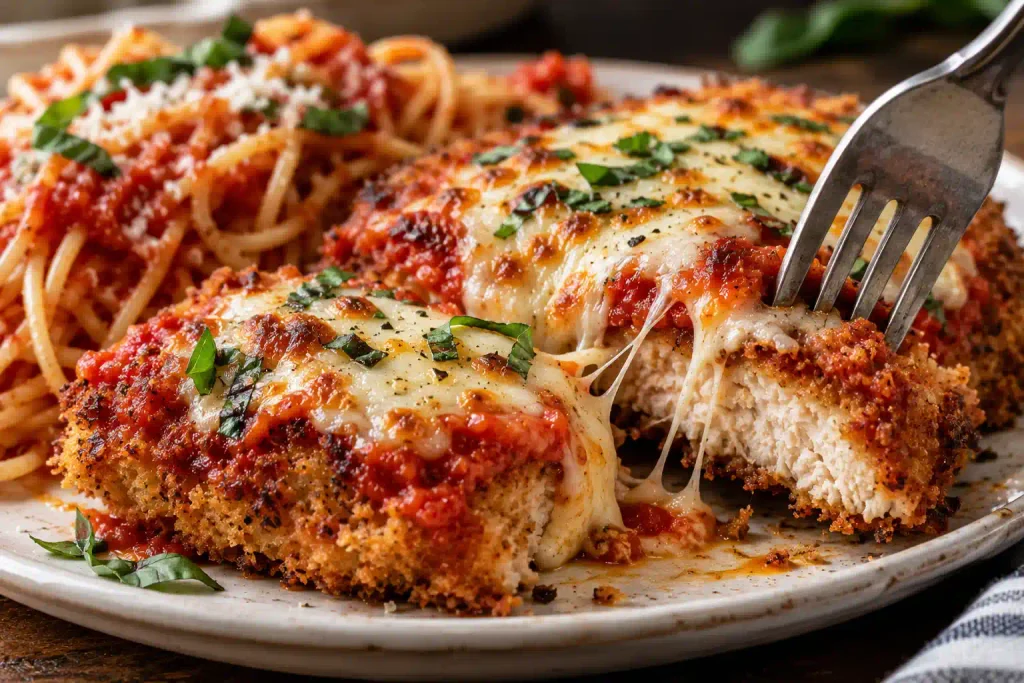
Serve this chicken parmesan recipe beside garlic butter spaghetti, not on top, so the noodles collect leftover sauce while the crumbs stay dry. A lemony arugula salad adds cold, peppery leaves and acid that cut the fried crust and mozzarella. Roasted broccoli brings charred, bitter edges that stand up to the cheese. Sparkling water with lime cuts the salt.
Frequently Asked Questions
Can I freeze chicken parmesan before cooking it?
Freeze the breaded, unfried cutlets on a tray for 1 hour, then bag them with the air pressed out. They keep 2 months. Thaw them overnight in the fridge and fry as this chicken parmesan recipe directs, since frying from frozen browns the crumbs while the center is still icy. Blot the thawed cutlets and rest them 5 minutes so the coating grips.
Why is my chicken parmesan brown outside but pink inside?
Oil above 375°F (190°C) is the usual cause: the crumbs color in about a minute while the center has barely warmed. Thick cutlets make it worse. Hold the oil at 350°F (175°C) and pound the meat to 1/2 inch (1.25 cm), so the skillet only browns and the oven does the cooking. A cutlet that looks nearly done in the skillet is not.
Can I use chicken thighs for chicken parmesan?
Boneless, skinless thighs work once pounded to 1/2 inch (1.25 cm), though they come out ragged, so trim the fat and expect about 30 seconds more per side than breasts need in the skillet. Thighs stay juicier than breasts in this chicken parmesan recipe and forgive an extra minute or two in the oven. Pull them at 175°F (80°C) for tender meat.
How do I know chicken parmesan is done?
A thermometer is the only dependable answer: slide the probe sideways into the thickest cutlet and wait for 165°F (74°C). Melted cheese proves nothing in a chicken parmesan recipe, because mozzarella turns stretchy well before the chicken is cooked through, and crust color was set in the skillet. Firmness is a fair backup: a finished cutlet feels springy under a fingertip, not soft and yielding.
Is chicken parm supposed to be soggy?
Restaurant plates often arrive smothered. A soft crust feels normal there, but crunch at the rim is doable. This chicken parmesan recipe keeps a dry collar, the outer 3/4 inch (2 cm) free of sauce, for a crisp border and a softer center. The trade is a plate less blanketed than the diner version, so spoon extra sauce beside the cutlet if you miss the look.
The Step Worth Protecting
Protect the 10 minute rest above everything else. Nothing crunches unless the breading has had time to bond, and no oil temperature fixes a coating that slides. After that the collar does its work, keeping the outer crumbs dry while the center takes the sauce.
On a good batch, the fork makes a dry snap at the rim and a soft press through the middle, in the same bite. Mine went pale a few times before the oil held a steady 350°F (175°C), so let it settle first. Pin this chicken parmesan recipe to your dinner board on Pinterest so the timings are waiting when the oil heats.

Chicken Parmesan
Ingredients
Method
- Simmer oil, garlic, tomatoes, sugar and salt for 15 minutes at about 195°F (90°C) until a spoon leaves a trail. Stir in the basil.
- Split each breast into two cutlets and pound to 1/2 inch (1.25 cm). Salt and pepper both sides.
- Flour, egg, then panko mix. Rest on an oiled rack for 10 minutes.
- Fry two at a time in 350°F (175°C) oil, 2 1/2 minutes per side, to deep gold. Drain on the rack.
- Put 3 tbsp (45 ml) sauce, mozzarella and Parmesan on each center, leaving a 3/4 inch (2 cm) bare edge.
- Bake in the middle of a 425°F (220°C) oven for 8 to 10 minutes, until the cheese blisters and the center reads 165°F (74°C).
- Stand 3 minutes. Plate with the remaining sauce alongside.