Arroz Con Leche Recipe, 7 Ingredients and Creamy Every Time
Arroz con leche turns grainy more often than it turns creamy, and the reason usually traces back to one rushed minute near the middle of the pot. Most recipes dump rice, milk, and sugar into one pan and simmer until it looks thick enough. That method works, sort of, but the centre of the pudding often stays thin while the edges turn pasty, because the rice never gets a fair chance to soften before milk proteins start tightening around the starch.
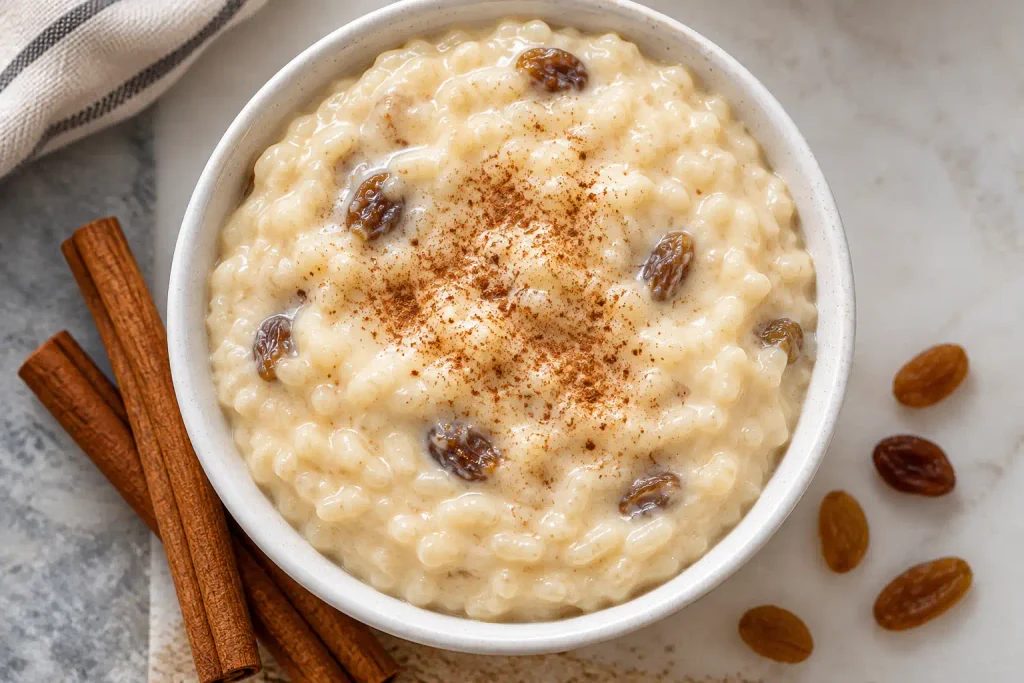
This arroz con leche recipe cooks the rice in water first, until the grains are almost tender, then finishes the pot in milk. The second half also uses a trick most home versions skip: tempering one egg yolk into the hot pudding right at the end for a glossier finish, without the scrambled streaks that scare people off trying it. From dry rice to a spoon-ready bowl takes about fifty minutes, and every stage below has something you can see, smell, or feel, not just a timer to watch.
Why You’ll Love This
- Two ingredients do the heavy lifting. Evaporated milk and a single egg yolk carry most of the richness, so the body reads custard-like without cream or butter.
- The grain stays whole. Cooking the rice in water first keeps each grain distinct instead of collapsing into paste.
- One pot, one pan wash. Everything happens in one heavy saucepan, start to finish.
- Keeps well for four days. Arroz con leche sets up firmer in the fridge and loosens again with a splash of milk.
- Reheats without breaking. A slow stovetop warm up keeps the texture close to fresh, which the microwave tends to ruin.
Quick Information
- Prep time: 10 minutes
- Cook time: 40 minutes
- Total time: 50 minutes
- Servings: 6, about 1 cup each
- Difficulty: Easy
- Decides the outcome: the egg yolk, tempered slowly at the end
- Best for: a weeknight dessert or a make ahead treat for guests
If the pudding looks thin right off the stove, trust the process. Arroz con leche keeps thickening for a good ten minutes off the heat as the starch finishes absorbing liquid, and again once it chills.
Nutrition Information
| Nutrient | Amount Per Serving |
| Serving Size | 1 cup (240 g) |
| Servings Per Recipe | 6 |
| Calories | 245 |
| Protein | 7 g |
| Carbohydrates | 42 g |
| Fat | 6 g |
| Fiber | 1 g |
| Sugar | 24 g |
| Sodium | 95 mg |
Most of the protein in arroz con leche comes from the two milks and the egg yolk, not the rice. Fat sits almost entirely in the milks, since there’s no added butter or cream. Sodium stays low, since the only salted ingredient is the pinch in the cooking water. Values are estimates that vary with brands and substitutions.
Ingredients
For the rice base
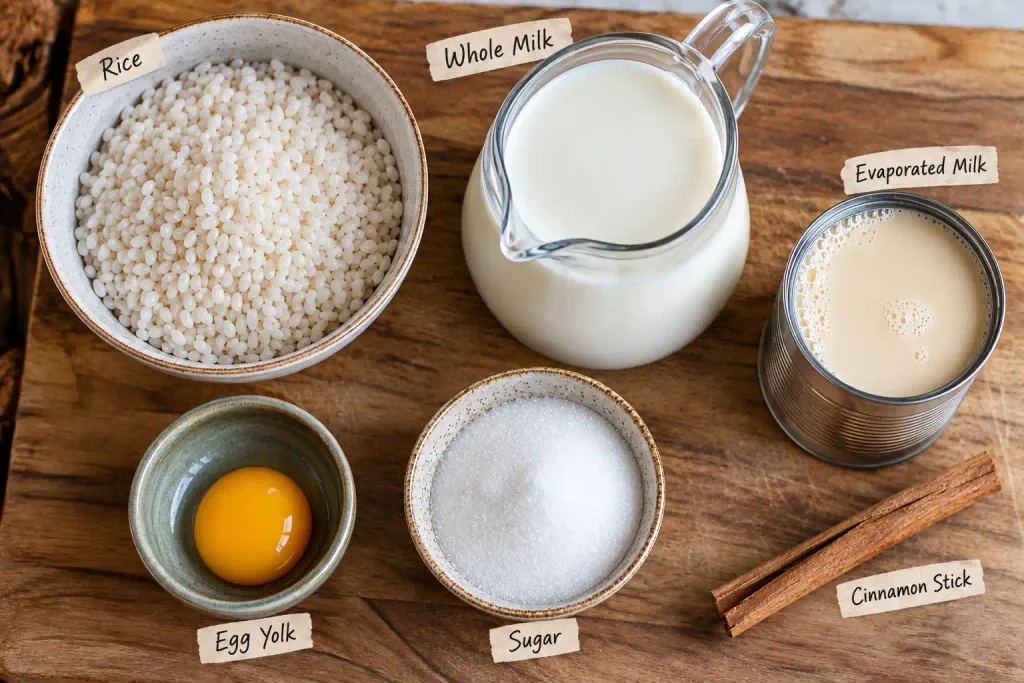
- 1 cup (200 g) long grain white rice, rinsed until the water runs mostly clear. Rinsing removes surface starch that would otherwise turn the pudding gluey.
- 2½ cups (600 ml) water
- 1 cinnamon stick, about 3 inches. Whole cinnamon infuses evenly; ground cinnamon this early turns the liquid muddy.
- ¼ teaspoon salt
For the milk stage
- 3 cups (720 ml) whole milk. Low fat milk works, but the pudding sets thinner.
- 1 can (12 oz / 354 ml) evaporated milk, the ingredient that pushes this from ordinary to genuinely creamy.
- ⅔ cup (135 g) granulated sugar
- 1 teaspoon vanilla extract
- 1 large egg yolk, for tempering at the end. Skip it for an eggless version; see the variations section.
Water and salt are pantry staples here, not part of the 7 headline ingredients that make up arroz con leche: rice, cinnamon, whole milk, evaporated milk, sugar, vanilla, egg yolk.
Allergen and Dietary Disclosure
As written, this arroz con leche contains milk, from the whole milk and evaporated milk, and egg, from the tempered yolk. It has no wheat, tree nuts, peanuts, soy, sesame, fish, or shellfish.
Dietary status as written: halal, vegetarian, gluten free, nut free, soy free. Not dairy free or egg free.
For a dairy free version, full fat coconut milk replaces both milks, though the pudding turns looser and picks up a coconut note. Leaving out the egg yolk removes the only egg allergen; the variations section covers keeping the texture glossy without it.
Watch pre-ground cinnamon from bulk bins, which sometimes carries cross contact with tree nuts from shared equipment.
Equipment Needed
- Heavy bottomed saucepan, at least 3 quarts. A thin pan lets the sugar and milk in arroz con leche scorch before the pot’s centre even registers hot.
- Wooden spoon. Scrapes the pan bottom cleanly, needed every few minutes for most of forty minutes.
- Fine mesh strainer. Used once, to catch the cinnamon stick and stray bits.
- Small whisk. For beating the yolk smooth before tempering; a fork works, but the whisk blends faster.
- Liquid measuring cup. Milk measured by eye tends to run short, and this recipe has little room for a thin batch.
Preparation
Rinse the rice under cold water until it runs mostly clear, then drain while you measure everything else. Set the sugar, vanilla, and salt into small dishes so they’re ready without digging through the pantry mid-simmer. Set the egg yolk in a small bowl near the stove for the arroz con leche tempering step; it goes in fast at the end. If your cinnamon stick smells faded, use two.
Step by Step Directions: How to Make Arroz Con Leche
Step 1. Simmer the rice in water
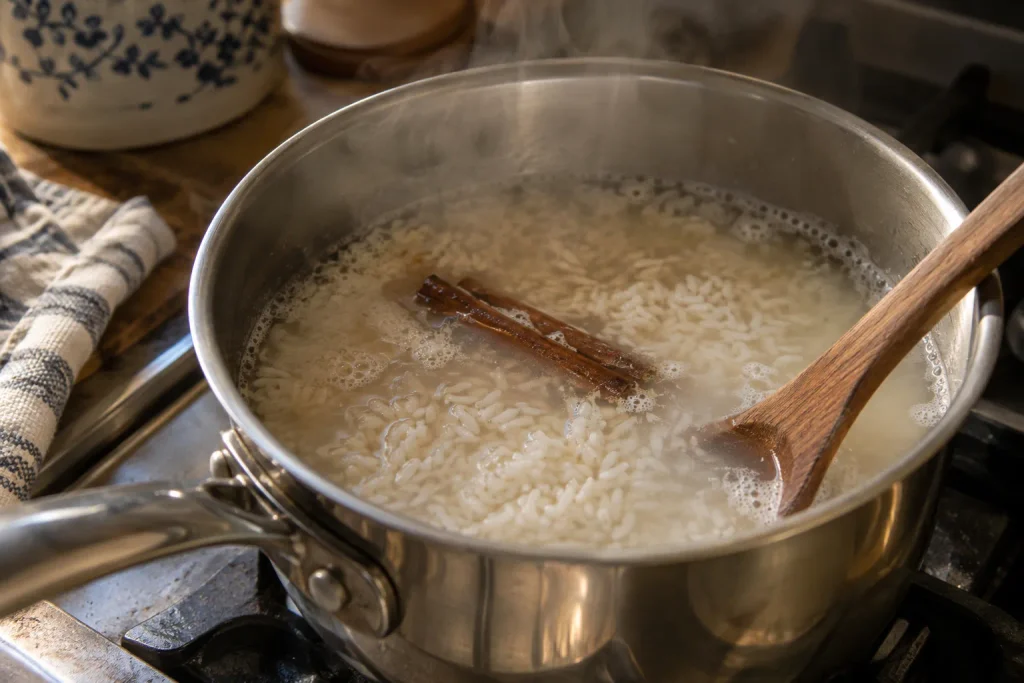
Combine the rinsed rice, water, cinnamon stick, and salt in the saucepan over medium-high heat. Bring to a boil, drop to a bare simmer, and cover. Give it 15 minutes. The water should be fully absorbed and the grains swollen, just short of fully tender.
Chef’s Note: If water is still pooling at 15 minutes, keep going in two minute bursts rather than adding milk early. Milk over unabsorbed water is the single most common cause of a grainy centre.
Step 2. Add the milk and sugar
Pour in the whole milk, evaporated milk, and sugar, stirring to loosen anything stuck to the pan bottom. Bring back to a gentle simmer, uncovered, stirring every two to three minutes so the bottom never sits still long enough to catch.
Step 3. Reduce to a soft coat
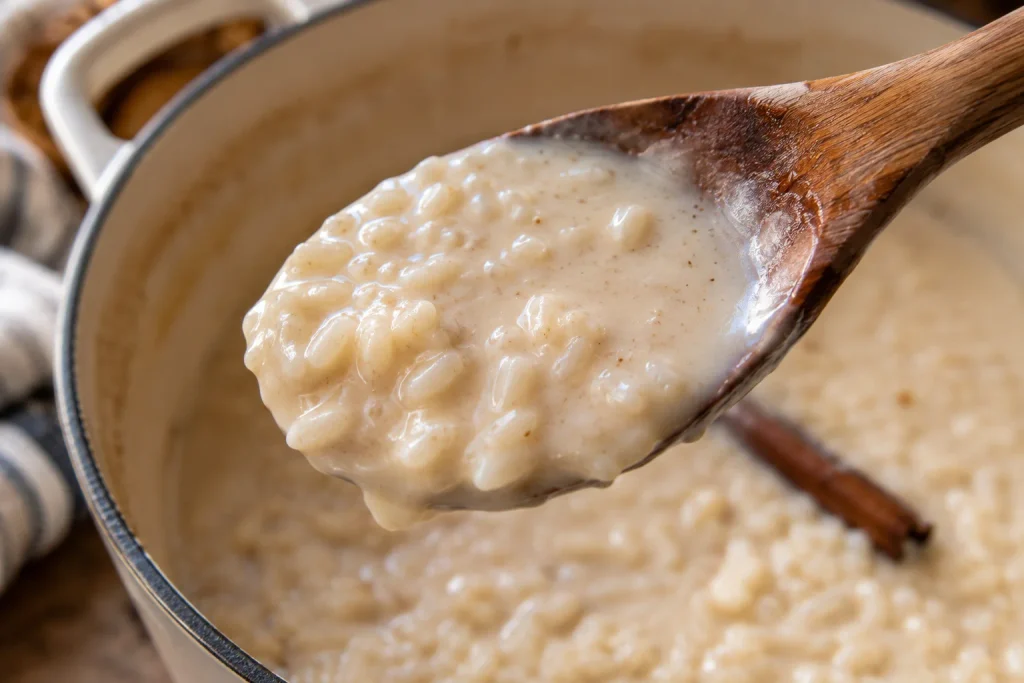
Let the pudding simmer uncovered for 20 to 22 minutes, stirring often, so it reduces (the liquid concentrates as water evaporates). It’s ready for the next step once it coats the back of the spoon in a thin, even layer and a line drawn through it holds for a second before slumping back.
Chef’s Note: It will still look looser than you’d expect here. That’s normal. Pulling it too thick on the stove means it turns stiff, almost paste-like, once it cools.
Step 4. Temper the egg yolk
Remove the pot from heat. Spoon about a half cup of the hot pudding into the bowl with the beaten egg yolk, whisking as you pour, then whisk that mixture back into the pot. This is tempering: raising the yolk’s temperature gradually instead of hitting it with full heat, which keeps it from scrambling into visible streaks.
Chef’s Note: Pour slowly, in a thin stream, not all at once. A yolk hit with the full heat in one splash curdles even off direct flame.
Step 5. Finish over low heat
Return the pan to low heat and stir constantly for 2 minutes, no more, until glossy and slightly thicker. It should never come back to a boil here; a boil now scrambles the egg.
Step 6. Add vanilla and rest
Remove from heat, stir in the vanilla, and fish out the cinnamon stick. Let the pot sit 10 minutes before serving. It visibly tightens during this rest as the starch absorbs the last of the liquid; don’t add extra milk just because it still looks thin.
Expert Tips and Tricks
Rinse the rice, don’t skip it. The surface starch that rinsing removes is exactly what turns arroz con leche gluey under a long simmer.
The mistake that scorches most batches: stirring in tight circles. That just moves the risk around the pan edge. Pull from the centre outward, so the sugar-heavy part of the pot keeps moving through the coolest zone.
Make arroz con leche up to two days ahead. Flavour improves overnight as the cinnamon keeps steeping, and the texture firms up closer to a set pudding.
Loosen with milk, never water, when reheating. Water dilutes flavour and texture.
Short on time? Skip the egg tempering. It sets a touch less glossy but still turns out creamy from the two milks alone, and saves the trickiest five minutes.
Taste the milk mixture before it thickens. Sugar is easier to adjust in a thin pot than a thick one.
Whole milk and evaporated milk are not interchangeable one for one here. Evaporated milk is already reduced, so it carries more concentrated flavor and protein than the same volume of whole milk would, which is why the recipe uses both.
Common Mistakes and Troubleshooting
| Problem | Cause | Solution |
| The centre stays watery even after 40 minutes | The rice went into milk before absorbing enough water, so the arroz con leche never built the structure that thickens the pot | Rest 10 minutes off heat, then simmer 5 more if still loose. Next time, confirm the water is gone before adding milk |
| Small scrambled specks appear after the egg yolk goes in | The hot pudding hit the raw yolk too fast, cooking its outside before it could blend in | Strain through a fine mesh sieve. Next time, pour the tempering liquid in a slow thin stream while whisking |
| A scorched layer forms on the pan bottom | The heat ran too high, or the pan went more than three minutes between stirs | Do not scrape the burnt layer in. Ladle the clean pudding into a fresh pot and drop the heat a notch |
| The pudding turns almost solid in the fridge | The starch kept absorbing liquid overnight, normal unless the pot was simmered past the soft coat stage | Stir in 2 to 3 tablespoons of milk per serving before reheating |
The scrambled egg specks worry people most, and they’re the easiest to fix mid-batch. Hot liquid meeting a raw yolk too fast sets its outer layer before it can blend, leaving flecks suspended in the pudding. Straining removes them completely and changes nothing about the flavor. The real fix sits upstream: pour slowly, whisk constantly, add hot liquid to the yolk, never the reverse.
Storage Instructions: How to Store Arroz Con Leche
Refrigerator
Transfer arroz con leche to an airtight container once cooled, within about an hour of cooking. It keeps well up to 4 days, firming up by day two as the starch keeps pulling in liquid.
Freezer
It freezes acceptably for up to 1 month, though the texture turns grainier on thawing. Fine for batch cooking, not for a dish you want at its silkiest.
Reheating
Warm gently on the stove with 2 to 3 tablespoons of milk stirred in per serving until it loosens back to spoonable. A microwave works in 20 second bursts, stirring between each.
Make Ahead
This dessert holds up well made a day or two in advance, a genuinely practical choice for entertaining.
Room temperature storage isn’t recommended past the first hour, since dairy and egg content make it unsafe to leave sitting out.
Variations and Substitutions
Spicy version: a small pinch of ground clove or star anise alongside the cinnamon stick adds a sharper note to arroz con leche, though too much clove fights the vanilla.
Mild or kid friendly version: cut the cinnamon stick to half; kids often read a full stick as too strong.
Vegetarian version: already vegetarian as written; egg yolk is the only animal product beyond dairy.
Gluten free version: naturally gluten free, no changes needed, though it’s worth checking your vanilla extract is labeled gluten free.
Eggless version: leave out the yolk and simmer 3 extra minutes to compensate for the thickening it would have added. A touch less glossy, still creamy from the two milks.
Brown sugar swap: light brown sugar in place of granulated pushes flavour toward caramel, a trade some prefer and others find too heavy against the cinnamon.
Serving Suggestions
Serve arroz con leche warm in cool weather, with a light dusting of ground cinnamon just before it reaches the table; ground spice blooms faster than the whole stick and gives a sharper first note.
Serve chilled in warm weather, straight from the fridge, since the firmer cold set holds up better on a hot afternoon than a warm bowl would.
A few toasted pecans or raisins on top add textural contrast against the smooth base.

Pair it with strong coffee or Mexican hot chocolate; bitterness in both cuts the sweetness rather than adding to it.
For a full dessert spread, it sits well next to something citrus forward, since the acidity resets the palate between rich bites.
Frequently Asked Questions
Can I make arroz con leche ahead of time?
This pudding actually improves after a day in the fridge, as the cinnamon keeps infusing into the base and the texture sets into something closer to a proper pudding than a loose porridge. Make it up to 2 days ahead, store it covered, and loosen with a splash of milk before serving if it has firmed up more than you’d like.
Why did my arroz con leche turn out grainy?
Graininess almost always traces back to the rice going into milk before it finished absorbing water in the first stage. Milk proteins interfere with starch swelling more than plain water does, so rice that starts in milk too early stalls out half cooked. Confirm the water is fully absorbed and the rice is nearly tender before adding any milk at all.
What can I use instead of evaporated milk?
Half and half works in a pinch, though the pudding loses some of the caramelized flavor evaporated milk provides. Whole milk alone also works, but expect a thinner result unless you simmer a few extra minutes to compensate. A small splash of heavy cream near the end can make up some of that lost richness, though it won’t fully replace evaporated milk’s flavor.
How do I know when arroz con leche is done cooking?
It’s done when the pudding coats the back of a spoon in a thin, even layer and a line drawn through that coating holds for a second before slumping back. It will still look loose on the stove; the final thickening happens during the 10 minute rest and again once it chills. Resist keeping it on the heat past this point just to force a thicker result, or it turns stiff and pasty later.
Is arroz con leche supposed to be soupy or thick?
Neither extreme is right. Straight off the stove it should be a loose, pourable custard, not soup and not a stiff pudding. It firms up considerably as it sits, so judging thickness the moment it leaves the heat almost always makes you think it needs more time when it doesn’t. Give the full 10 minute rest before deciding whether more stove time is necessary.
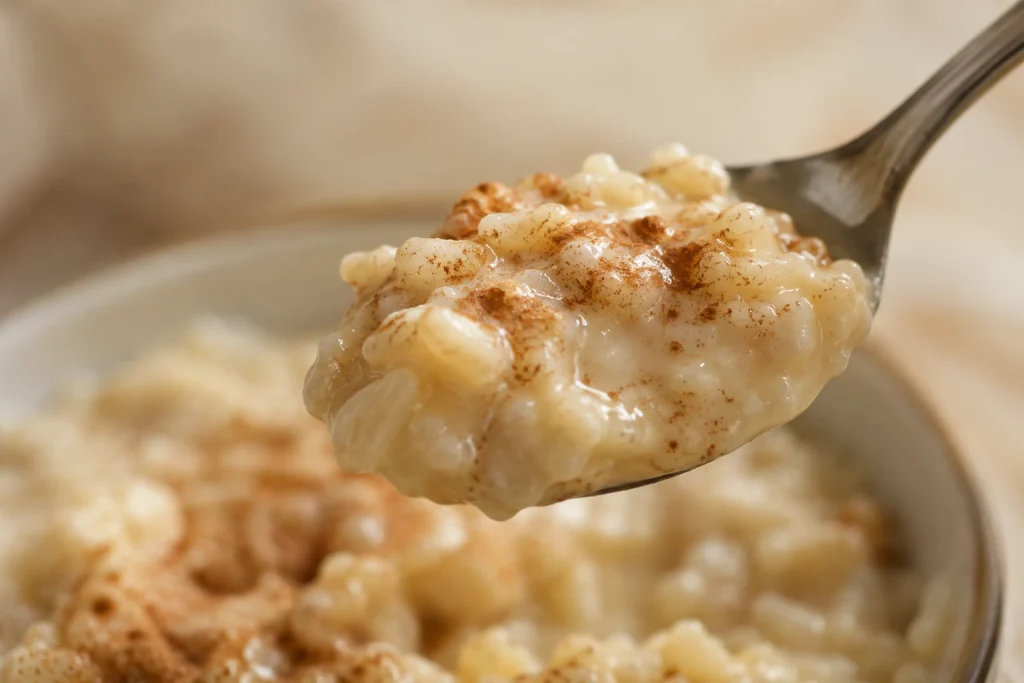
Patience matters more than skill here. The two stage cooking method, water first and milk second, is the one habit that separates a grainy pot from a genuinely creamy one, and it costs nothing beyond about fifteen extra minutes of attention at the stove. The egg yolk tempering at the end is optional, but it is the step that turns a good arroz con leche into one that looks and tastes like it came from someone who has made this a hundred times.
Keep a close eye on the pot during the milk stage instead of walking away. Scorched milk on the bottom of the pan is the one mistake this recipe cannot fully hide once it happens. Pin this recipe now so it is easy to find the next time cinnamon and rice pudding sound like exactly what the evening needs.
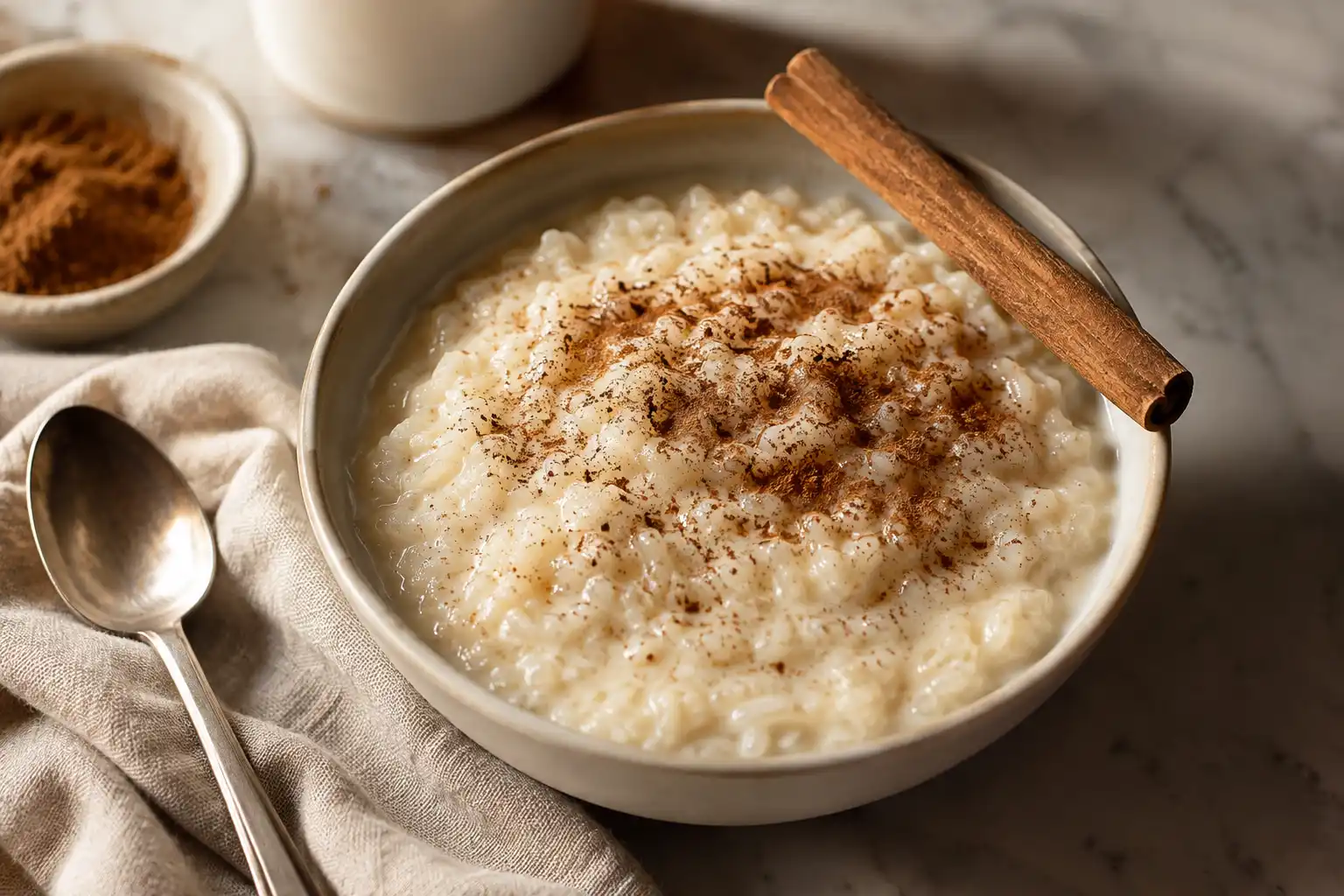
Arroz Con Leche
Ingredients
Method
- Simmer rinsed rice with water, cinnamon stick, and salt, covered, 15 minutes, until water is absorbed.
- Stir in whole milk, evaporated milk, and sugar; bring to a gentle simmer, uncovered.
- Simmer 20 to 22 minutes, stirring often, until the mixture coats the back of a spoon.
- Off heat, temper the beaten egg yolk with a half cup of the hot pudding, then whisk it back into the pot.
- Return to low heat; stir constantly 2 minutes until glossy. Do not let it boil.
- Off heat, stir in vanilla, remove the cinnamon stick, and rest 10 minutes before serving.