Chicken Noodle Soup Recipe: A Hearty Broth Ready in 60 Minutes
Chicken noodle soup lives or dies on the broth. Everything else, the noodles, the carrots, the shredded chicken, rides along once you’ve got a pot of stock that actually tastes like chicken instead of salted water with good intentions.
Most recipes have you poach a whole bird for an afternoon. It works, but half the breast meat dries out before the broth has any real flavor. Bone-in thighs fix that: pound for pound they carry more skin and connective tissue, so they give off gelatin fast, and 45 minutes builds a broth with actual body, no bouillon cube required.
The part that throws people off is the first ten minutes, when the broth turns cloudy and gray with rough foam on top. That’s just protein coagulating out of the meat, not a sign anything’s wrong, and skimming it off is the one step in this chicken noodle soup recipe that decides whether your broth ends up clear.
Why You’ll Love This
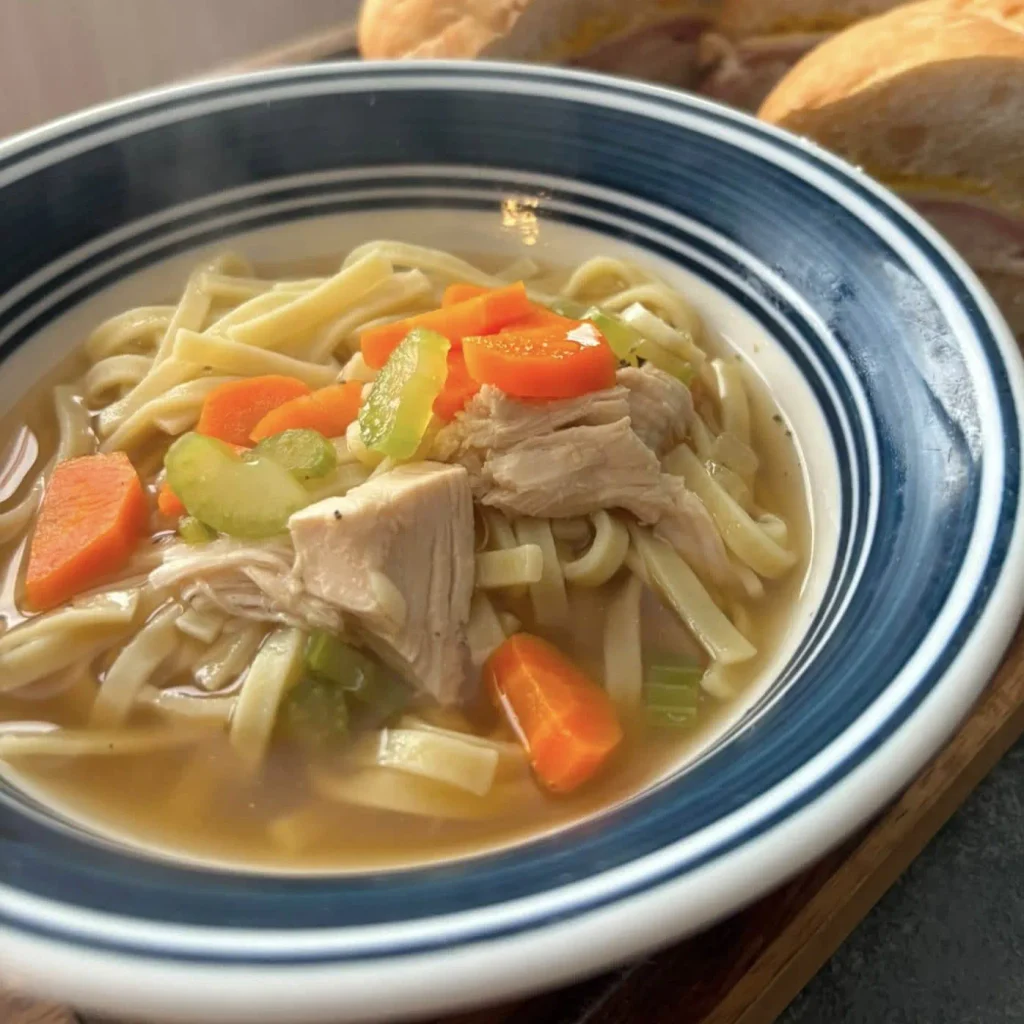
- Broth with real body. Bone-in thighs give off enough gelatin in 45 minutes to coat a spoon.
- One pot, minimal cleanup. The chicken poaches, the vegetables soften, and the broth reduces in the same pot.
- The noodles stay out of the pot until serving. Store them apart and this chicken noodle soup freezes for two months without a soggy noodle.
- Cheaper than a whole bird, with six full bowls from thighs that cost less per pound.
- Ready inside an hour. No brine, no roasting a whole chicken first, just a simmer that fits a weeknight.
- Gentle on a sick stomach. Mild seasoning and soft noodles go down easy when nothing else sounds good.
Quick Information
- Prep Time: 15 minutes
- Cook Time: 45 minutes
- Total Time: 60 minutes
- Servings: 6
- Difficulty: Easy
- Calories: 280 per serving
- The ingredient that decides the outcome: bone-in, skin-on chicken thighs, for the gelatin they release
- Best for: a weeknight dinner, a sick day, or a make-ahead lunch
Nutrition Information
| Nutrient | Amount Per Serving |
| Serving Size | 1.5 cups (360 g) |
| Servings Per Recipe | 6 |
| Calories | 280 |
| Protein | 22 g |
| Carbohydrates | 24 g |
| Fat | 10 g |
| Fiber | 2 g |
| Sugar | 3 g |
| Sodium | 780 mg |
Most of the protein in this chicken noodle soup comes from the thighs, with the noodles adding a smaller amount. Fat is mostly rendered skin plus the butter on the vegetables, and sodium climbs from the salt added at the end. Values are estimates that vary with brands, measuring, and substitutions.
Ingredients
For the Broth
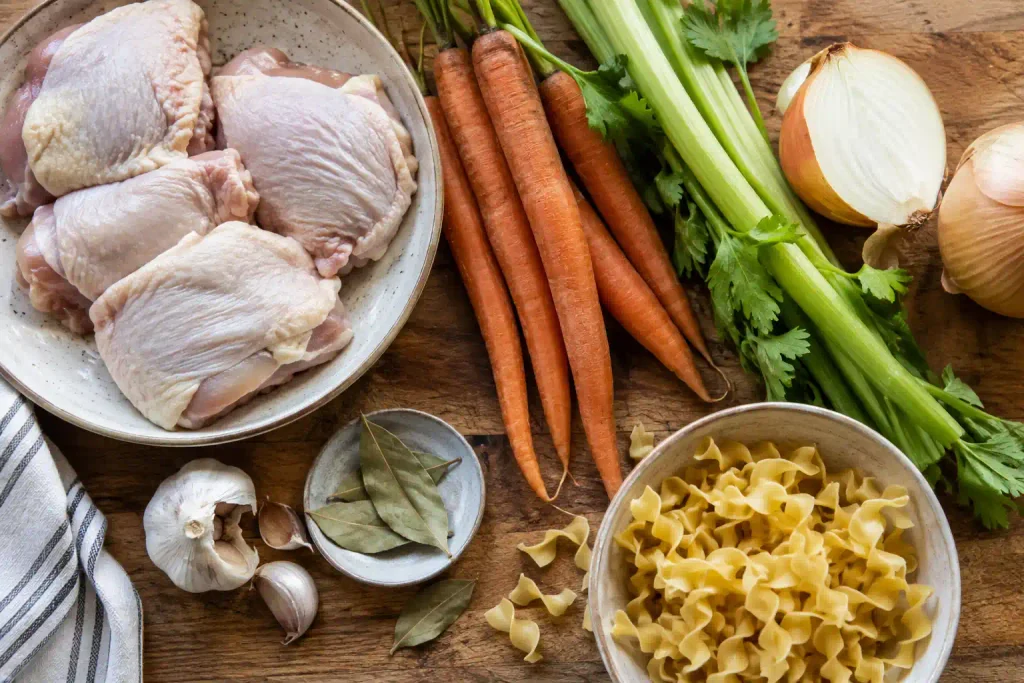
The onion, carrot, and celery form a mirepoix, the classic vegetable base for a broth.
- 2 lbs (900 g) bone-in, skin-on chicken thighs. The bone and skin build the body.
- 1 large yellow onion, quartered
- 1 large carrot, quartered, plus 3 medium carrots, diced, divided
- 3 celery stalks, sliced, plus leafy tops reserved, divided
- 4 garlic cloves, smashed so they’re easy to fish out later
- 2 bay leaves
- 1 tsp whole black peppercorns
- A small handful of fresh parsley stems, or 1/2 tsp dried thyme
- 10 cups (2.4 L) water
- Kosher salt, added at the end
For the Soup
- 2 tbsp butter, or olive oil
- 8 oz (225 g) wide egg noodles, cooked separately
- 2 tbsp fresh dill, chopped, plus more for serving
- 1 tbsp fresh lemon juice
- Black pepper, to taste
Rotisserie chicken can stand in for the raw thighs: shred about 3 cups and stir it in during the last 5 minutes, though the broth won’t build quite the same depth without bones simmering the whole time.
Allergen and Dietary Disclosure
This chicken noodle soup carries three allergens worth flagging. The egg noodles bring egg and wheat, and the butter used on the vegetables adds milk. No soy, tree nut, peanut, shellfish, or fish appears anywhere.
As written, it’s halal and nut free, but not egg free, gluten free, or dairy free. For gluten free, swap in rice noodles or certified gluten free egg noodles, cooked separately; rice noodles soften faster, so watch them closely. Swap the butter for olive oil to go dairy free. If you use store bought broth, check the label, since many carry wheat as a hidden filler.
For the clearest broth, strain it a second time through a sieve lined with a damp paper towel. It catches the fine particles a regular strainer misses.
Equipment Needed
- Large Dutch oven or stockpot. At least 6 quarts, so the thighs sit in a single layer while the broth comes up around them.
- Fine mesh strainer. Worth using for a fully clear chicken noodle soup; skip it if a few flecks don’t bother you.
- Instant read thermometer. Thighs are forgiving, but 165°F (74°C) at the thickest point tells you the meat’s done.
- Fat separator, or a wide spoon. The fat layer that rises after skimming is worth pulling off.
- Sharp knife and cutting board. Dicing the vegetables evenly keeps them cooking at the same rate.
Before You Start
Quarter the onion and cut the reserved carrot and celery into big, rough chunks, since they’re getting strained out later. Dice the remaining vegetables small and even, because this batch stays in the finished chicken noodle soup. Smash the garlic instead of mincing it, and have the noodle pot of salted water standing by, ready the moment the chicken comes out of the broth.
How to Make Chicken Noodle Soup, Step by Step
Step 1. Load the pot cold
A cold pot works better than a hot one. Add the thighs, quartered onion, big cut carrot and celery, smashed garlic, bay leaves, and peppercorns, then pour in 10 cups (2.4 L) water so everything sits submerged.
Step 2. Bring to a bare simmer
Set the pot over medium heat and let it climb slowly, about 12 minutes, until small bubbles break gently at the surface instead of a rolling boil. This is poaching, cooking gently in liquid just below a boil, which keeps the meat tender.
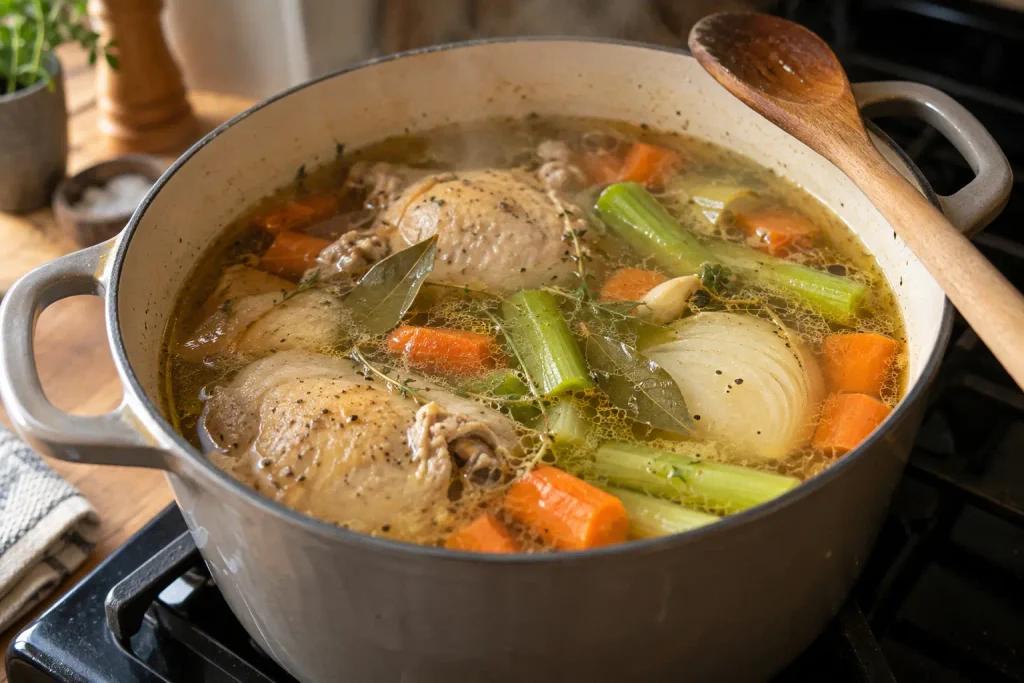
Chef’s Note: A hard boil here is the fastest route to cloudy, greasy broth. Agitation breaks the fat into droplets that stay suspended instead of floating on top.
Step 3. Skim the foam
Gray foam collects in the first ten minutes and looks worse than it is; that’s protein coagulating out of the meat. Skim it off every few minutes, then simmer gently, uncovered, for 35 minutes.
Step 4. Pull and shred the chicken
Lift the thighs out once a thermometer reads 165°F (74°C) at the thickest part, usually around the 35 minute mark. Rest 5 minutes, then shred off the bone.
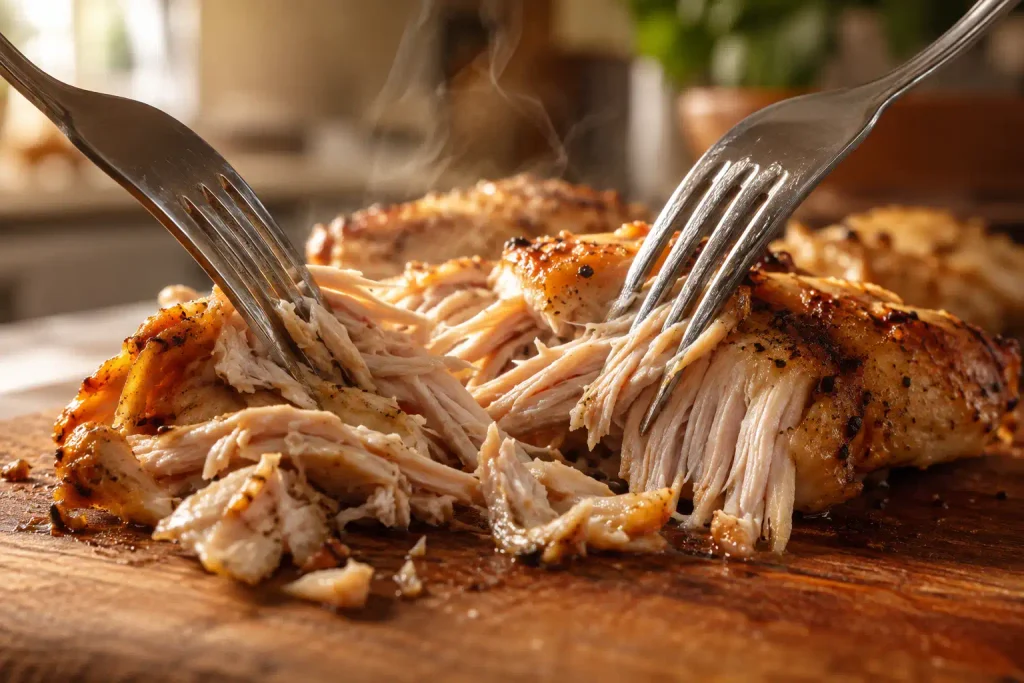
Chef’s Note: Shred while the chicken’s still warm. It pulls apart in long, even strands; cold chicken tears instead.
Step 5. Strain the broth
Pour the broth through a fine mesh strainer into a second pot, catching the vegetables, bay leaves, and peppercorns. Everything caught has already given up its flavor, so it goes in the bin.
Step 6. Soften fresh vegetables
Melt the butter in the empty pot over medium heat, then add the diced carrots and celery. Cook 6 to 7 minutes, until the carrots soften at the edges but still hold a slight bite.
Step 7. Cook the noodles separately
In a separate pot, bring 4 quarts of salted water to a boil and cook the noodles 7 minutes, one minute short of the package time. Drain and toss with a little oil so they don’t clump.
Chef’s Note: This step keeps leftovers from turning to paste. Noodles cooked in the broth keep pulling in liquid in the fridge; by day two they’ve swollen into dumplings.
Step 8. Combine and season
Pour the strained broth back into the pot with the vegetables, stir in the shredded chicken, and simmer 5 minutes. Taste and season with salt, since the broth was unsalted until now.
Step 9. Finish and serve
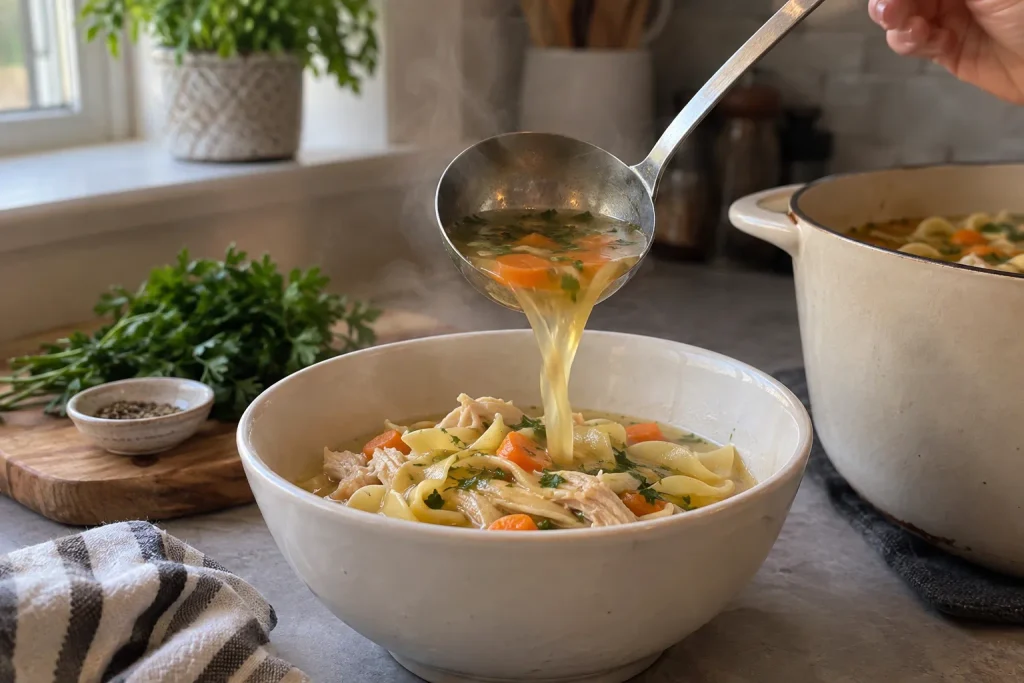
Off the heat, stir in the dill, pepper, and lemon juice. Divide the noodles among bowls first, then ladle the hot broth and chicken over top. Plating this way, rather than reheating noodles in the pot, keeps them from going soft.
Expert Tips and Tricks
Don’t skip the skim. The first ten minutes throw off the most foam, and walking away then leaves you with a muddier broth.
Make the broth a day ahead. It improves with an overnight rest, since the flavor settles and the fat rises into a layer you can lift off.
Store the noodles separately, every time. Broth kept with noodles already in it turns thick and starchy within a day.
Use thighs, not breasts, for a deeper chicken noodle soup. Breast meat dries out over a 35 minute simmer, while thighs stay tender the whole time.
Salt at the end, not the start. Salting the poaching liquid early concentrates as the broth reduces, and it’s easy to land oversalted.
Freeze broth in the portion you’ll reheat. Quart containers thaw faster than one giant batch.
A splash of acid at the end wakes the pot up. Lemon juice or vinegar cuts the richness and sharpens the broth.
Common Mistakes and Troubleshooting
| Problem | Cause | Solution |
| Broth turns cloudy and gray | The pot boiled hard instead of holding a bare simmer | Drop the heat to a bare simmer. Rescue a cloudy batch by straining through a paper towel lined sieve |
| Chicken shreds are dry and stringy | Breast meat was used, or thighs simmered well past 165°F internal | Pull the meat the moment it hits temperature, and use bone-in thighs next time |
| Noodles turn soft by the next day | Noodles cooked in the broth keep absorbing liquid in the fridge | Cook noodles separately and store them apart; add fresh noodles at reheating |
| Broth tastes thin no matter how long it simmers | Skinless, boneless meat was used, leaving too little collagen for gelatin | Switch to bone-in, skin-on thighs, or add two wings purely for gelatin |
| Soup is bland even after salting | Salt went in at the start and concentrated as the liquid reduced | Season in small additions near the end instead, tasting each time |
Cloudy chicken noodle soup broth is the mistake nearly everyone makes on the first try, and it happens fast, within minutes of a hard boil rather than gradually. The fat that should sit as a clean layer on top gets whipped into the liquid instead, turning it gray. There’s no full fix, but straining through a paper towel lined sieve pulls most of the cloudiness back out.
Storage Instructions
Room temperature storage isn’t safe for a broth based soup like this; it sits in the danger zone too long once it cools, so get it into the fridge within two hours.
Refrigerator
Store the broth, chicken, and vegetables together for up to 4 days, keeping the noodles in their own container. The broth turns gelatinous when cold and loosens back up once reheated.
Freezer
The broth freezes well for up to 2 months in a flat freezer bag, which thaws faster than a rigid container. Skip freezing the noodles; cook a fresh batch instead, since thawed noodles turn mealy.
Freeze leftover broth in ice cube trays for quick additions to rice, gravy, or a fast pan sauce whenever you only need a splash.
Reheating
Warm this chicken noodle soup’s broth and chicken over medium low heat until it reaches a gentle simmer, about 8 to 10 minutes from cold. Add the noodles for the last minute or two, just long enough to warm through.
Make Ahead
This chicken noodle soup broth can be made up to 3 days in advance and stored on its own, which improves the flavor since the fat solidifies on top and lifts off cleanly. Cook the noodles the day you plan to serve.
Variations and Substitutions
Spicy variation. Stir a diced jalapeno or a teaspoon of chili flakes into this chicken noodle soup with the carrots and celery. Start light, since chili heat keeps building as it sits.
Mild or kid friendly variation. Skip the black pepper and cut the vegetables smaller. You lose a little warmth, but it stays approachable for picky eaters.
Vegetarian variation. Swap the thighs for two cans of drained chickpeas and build a rich vegetable stock with the same aromatics for a meatless chicken noodle soup. It won’t gel like a bone based broth, so lean on extra butter for body.
Gluten free variation. Use rice noodles or a certified gluten free egg noodle in this chicken noodle soup, cooked separately. Rice noodles cook faster, so pull them a minute early.
Bone broth shortcut. Short on time, swap half the water for homemade chicken broth made ahead. You’ll trade some depth for roughly 15 minutes off the total.
Herb swap. Fresh thyme works in place of dill, though it brings an earthier note than dill’s bright, slightly anise-like flavor.
Serving Suggestions
Crusty bread or dinner rolls are worth having on the table for soaking up the last of the broth. Serve alongside easy homemade dinner rolls for a full cold weather meal.
A simple green salad with a sharp vinaigrette works too; the acidity cuts through this chicken noodle soup’s richness. Grated parmesan or crushed crackers add salty crunch against the soft noodles.
Want a change of pace? chicken and rice soup uses the same bone-in broth method with rice standing in for noodles. Hot tea with lemon and honey matches the warmth and suits someone under the weather.
Frequently Asked Questions
Can I make chicken noodle soup ahead of time?
The broth holds up far better than the noodles do, so make it up to three days ahead and store it on its own in the fridge. Cook the noodles fresh right before serving and add them straight to each bowl. Making the whole pot ahead, noodles included, leaves you with soft, swollen noodles by the time you reheat it, even after just one night.
Why did my chicken noodle soup broth turn out cloudy?
A hard boil is almost always the cause of cloudy chicken noodle soup broth. Once the liquid agitates enough, the fat breaks into tiny droplets that stay suspended instead of floating on top, turning the broth gray. Holding the pot at a bare simmer, just a few small bubbles at a time, keeps the fat where it belongs. A cloudy batch can be strained through a paper towel lined sieve to pull most of it back out.
Can I use chicken breast instead of thighs?
Breast meat works, but it dries out faster over the same 35 minute simmer since it carries less fat and connective tissue than thighs. Pull it as soon as it hits 165°F (74°C), likely closer to the 25 minute mark rather than 35, and expect a slightly thinner broth, since breast meat gives off far less gelatin than a thigh does over the same cook time.
How long does chicken noodle soup actually take to cook?
Figure on an hour total for this chicken noodle soup recipe: 15 minutes to prep the vegetables and get the pot going, then about 45 minutes of simmering, shredding, and bringing everything back together at the end. The chicken itself needs roughly 35 minutes at a bare simmer to reach 165°F (74°C) through the thickest part of the thigh before it’s ready to shred.
What’s the deal with keeping the noodles out of the pot?
Noodles left sitting in hot broth keep soaking up liquid well after the pot’s off the stove, and by the next day they’ve swollen into something mushier than a noodle should be. Cooking them separately and adding them to each bowl at serving time keeps that texture intact, especially useful if you’re eating this over several days instead of one sitting.
Conclusion
Good broth rewards patience more than technique. This version, built from thighs instead of raw bones simmered for six hours with a full mirepoix, won’t taste identical to a stock made the long way. That’s a fair trade for a chicken noodle soup you can get on the table in an hour on a Tuesday. What matters more than any single step is keeping that simmer gentle and keeping the noodles out of the pot until the bowl’s in front of you. Both habits are small, and both are the difference between a broth that tastes clean and one that doesn’t. Pin this one for the next time someone in the house needs a bowl of something warm.

Chicken Noodle Soup
Ingredients
Method
- Add thighs, onion, big-cut carrot and celery, garlic, bay leaves, and peppercorns to a cold pot with 10 cups (2.4 L) water.
- Bring to a bare simmer over medium heat, about 12 minutes.
- Skim foam off the surface every few minutes for the first 10 minutes.
- Simmer uncovered 35 minutes total, until chicken reaches 165°F (74°C).
- Remove chicken, rest 5 minutes, then shred and discard skin and bones.
- Strain broth, discarding solids.
- Melt butter in the pot and cook diced carrots and celery 6 to 7 minutes.
- Boil egg noodles separately in salted water for 7 minutes; drain and toss with a little oil.
- Return strained broth and shredded chicken to the pot with the vegetables; simmer 5 minutes and season with salt.
- Stir in dill, pepper, and lemon juice off heat.
- Divide noodles into bowls and ladle broth and chicken over top to serve.